


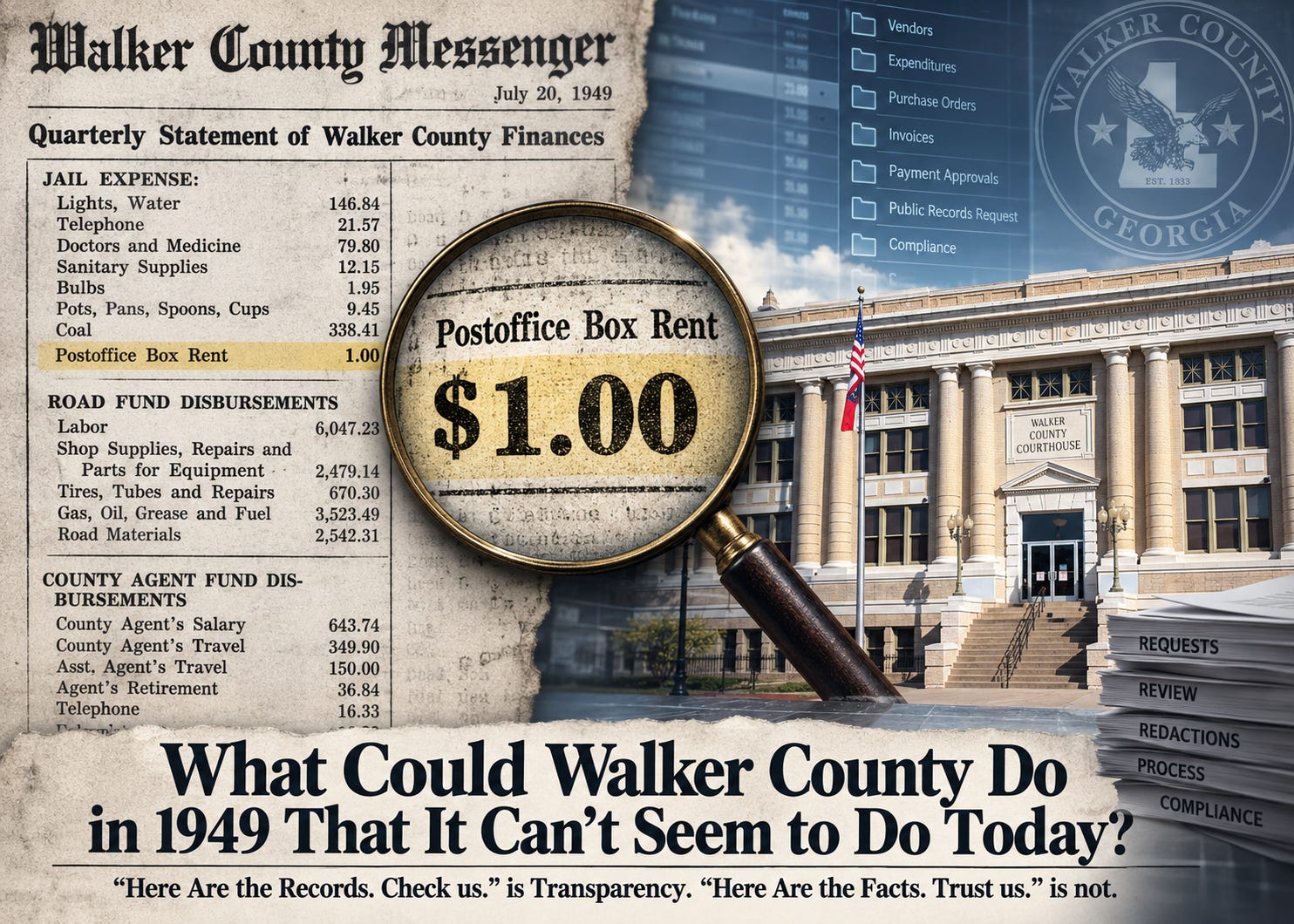
In July 1949, Walker County government spent exactly one dollar on post-office box rent.
I know this because Walker County told everybody.
It also told them about $9.45 spent on pots, pans, spoons and cups at the jail, $557.30 for courthouse coal, $402.40 for dynamite and caps, $670.60 for tires, tubes and repairs, $6,047.22 for road labor and $465 for the commissioner’s travel. Then there is my favorite little mystery in the whole report . . . $13.52 for “Axes for Ditches.”
Walker County even disclosed the cost of disclosing all of this.
It paid the Walker County Messenger $40 to publish the quarterly financial statement.
So, in 1949, Walker County spent $40 telling taxpayers it had spent $1.
Commissioner of Roads and Revenue Fay B. Murphey Sr. signed his name beneath the report and swore before a notary that it was a “full and true statement of the monetary transactions of my office.”
No website. No fancy accounting software. No NextRequest open records portal. Just Walker County showing taxpayers what it did with their money, right down to a one-dollar post-office box.
Seventy-seven years later, we have computers capable of sorting and exporting thousands of financial transactions in seconds or minutes, and citizens still have to go hunting to discover who Walker County paid, how much and for what. And even then it’s probable they will NOT get the information.
Talk about a strange kind of progress.
A Budget Is Not a Check Register
Before somebody at the county starts drafting a rebuttal, yes, Walker County publishes budgets, audits, SPLOST reports and other financial documents. Good. It should. But a budget is not a check register. An audit is not a running list of payments. A year-end financial statement does not tell you what happened in useful detail, and that distinction is the whole problem.
After more than a year of trying to get ordinary financial information from Walker County, I no longer think the most troubling part of this story is that the county has makes records requests difficult and avoids compliance.
The most troubling point is that these records requests have to be made in the first place.
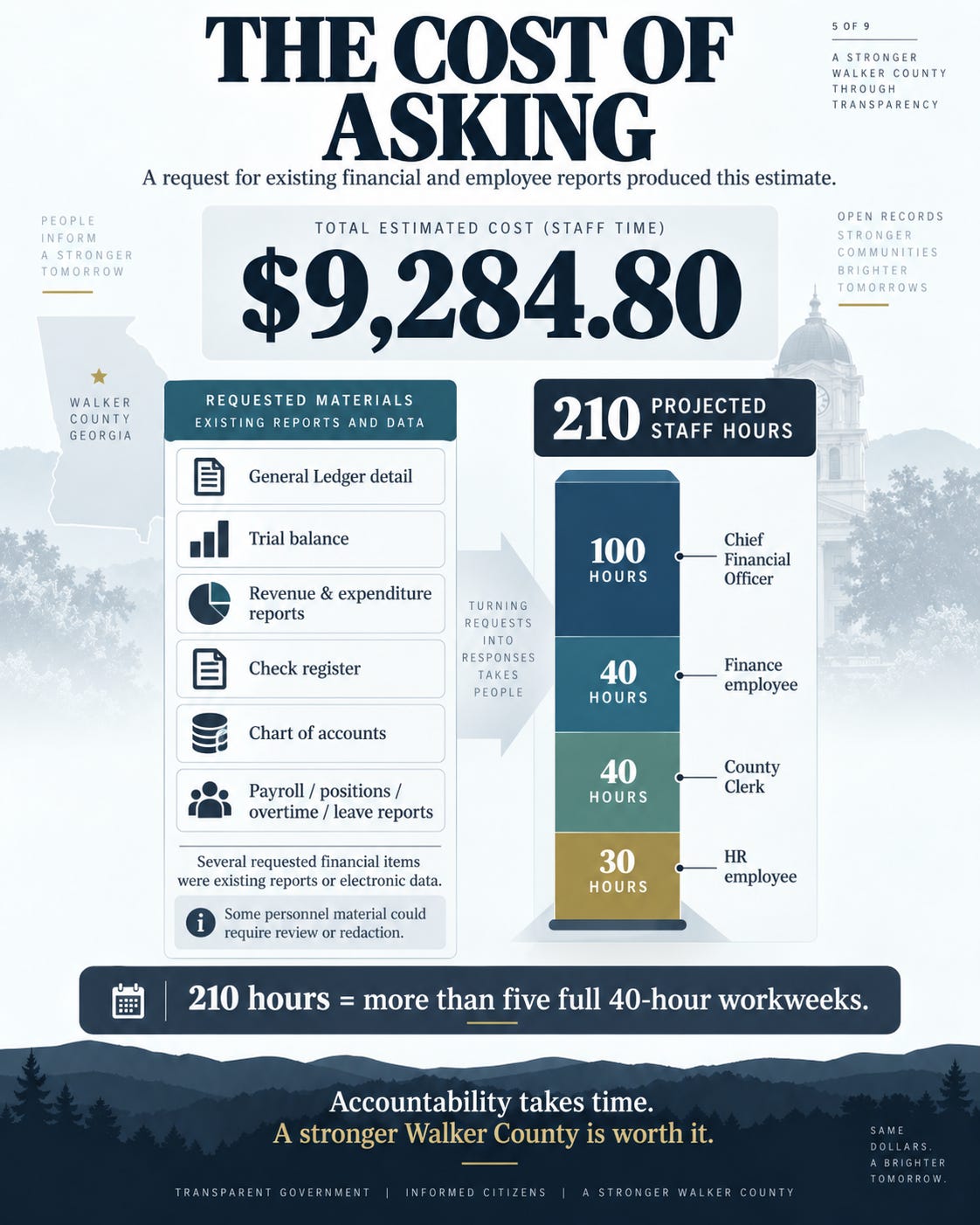
In September 2025, I asked Walker County for financial and employee reports from the Tyler Technologies systems it uses to manage county finances and personnel. On the financial side, that included General Ledger detail, a trial balance, revenue and expenditure reports, a check register and the chart of accounts. The employee request involved payroll, positions, overtime, leave and related reports. Existing reports. Existing data. Excel or CSV where available.
I didn’t request handwritten bookkeeping files from the Truman administration stored in a box beneath somebody’s desk.
Chairwoman Angie Teems texted me that it was “a lot of data,” would take time and would be expensive. She compared what I wanted to “an audit that our auditors would do annually.” Then came the estimated fee to obtain the records.
$9,284.80.
Walker County projected it would take 100 hours of its chief financial officer’s time, 40 hours from another finance employee, 40 hours from the county clerk and 30 hours from an HR employee. Two hundred and ten staff hours . . . more than five full workweeks . . . for records and reports sitting inside government accounting software and systems. Standard reports
The county will say the estimate followed Georgia’s open-records fee rules, so many hours at so much an hour, with the first 15 minutes free. The law may permit fees. The law does not require the conclusion that five workweeks of human labor stand between a citizen and reports the software already holds. Not to mention the fact that all of this is public records the citizens already pay for.
Some personnel material could require review and redaction. Sure. But tucked inside that $9,284.80 estimate were considerably less mysterious creatures: a General Ledger, trial balance, check register and chart of accounts.
Not exactly the nuclear launch codes.
I talked with Teems. Commissioner Mark Askew called me too. The conversations were cordial. But cordiality is not transparency. A government can smile at you while making information practically inaccessible, and $9,284.80 is a pretty effective smile.
Click here to read the full correspondence related to this instance.
.Seven Requests Are Still Seven Requests
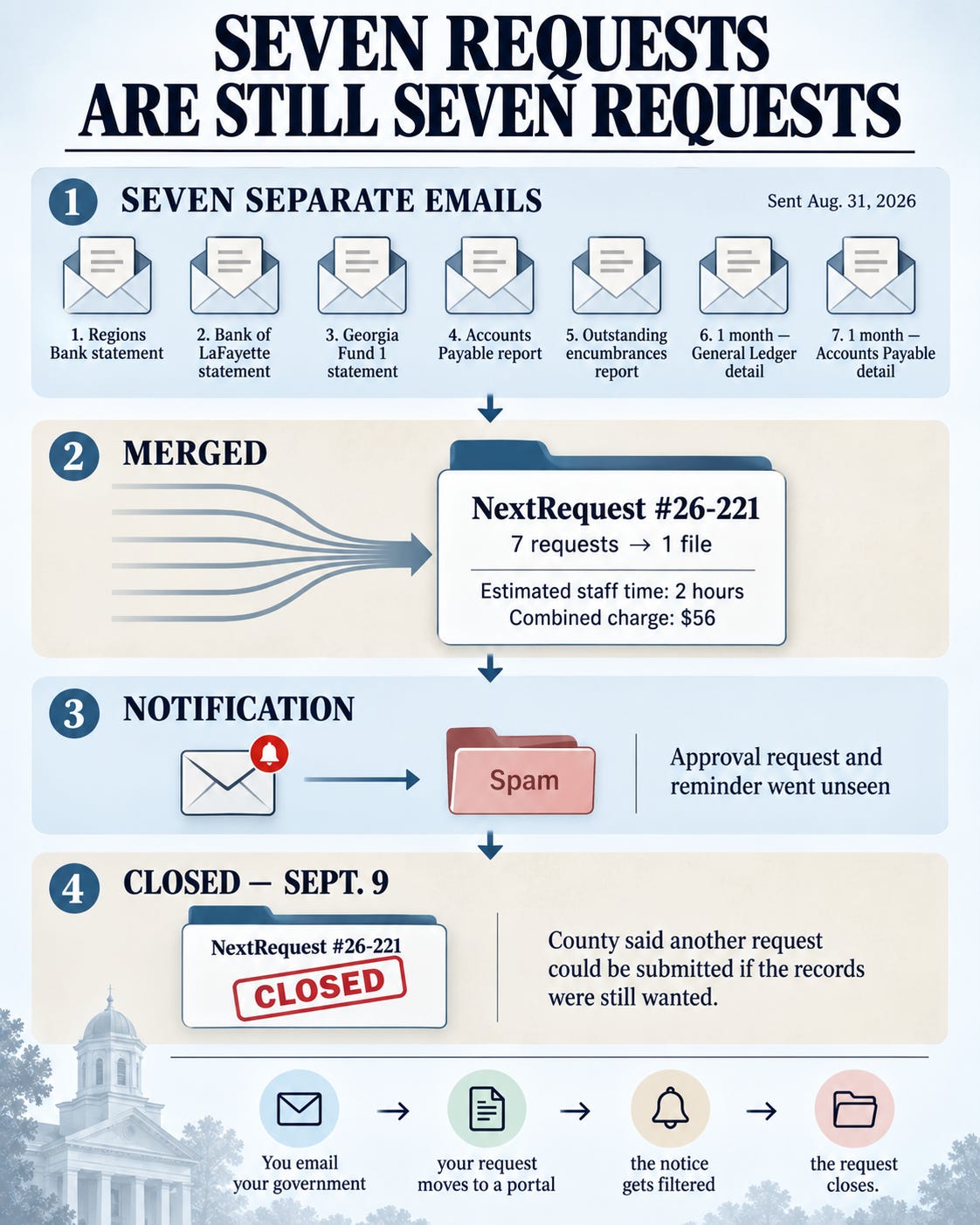
So this year I tried something different. On Aug. 31, I sent seven separate, deliberately narrow requests directly to Walker County’s designated records custodian. Seven emails, seven subject lines. Three were almost embarrassingly simple: the most recent account statements from Regions Bank, Bank of LaFayette and Georgia Fund 1. Two sought existing reports showing Accounts Payable and outstanding encumbrances. The final two asked for one completed month of General Ledger and Accounts Payable transaction detail.
I explicitly said I was not asking county employees to retrieve every invoice, purchase order, canceled check or supporting document. I wanted the existing reports and electronic exports.
Walker County took those seven requests and placed them into one NextRequest open records portal file, #26-221. The county’s Sept. 2 response says why. Because “multiple requests were received by email at approximately the same time,” they was put into the same file.
The requests did not arrive holding hands. A request for a Regions statement did not become united with an Accounts Payable report request because both arrived before lunch. But Walker County bundled them anyway, estimated two hours of staff time and produced a $56 charge.
Fifty-six dollars is not $9,284.80. It is also not really the point.
The automated NextRequest open records portal messages went to my spam folder. I never saw the $56 approval request or the reminder. Then, on Sept. 9, the county closed the entire combined request because I had not approved the charge . . . and told me I could submit another request if I still wanted the information. I discovered this by checking the portal, which was news to me, mostly because I had emailed the county clerk.
I had nothing to do with the portal. I emailed the legally designated records custodian
The county decided the actual conversation would occur through automated messages from a third-party software vendor. The messages were filtered. The county closed my requests. Somehow the burden migrated from the government inbox I contacted to a spam folder I did not know I was supposed to patrol. I don’t believe anyone at Walker County plotted to route my request into a junk folder. Nobody had to. That is what makes the system such a tidy hiding place . . . it fails citizens all by itself.
You email your government. Your government moves your request somewhere else. Somewhere else emails you. The email gets filtered. Your government closes the request. And apparently you’re the one who failed the process.
No.
I wrote the clerk, Teems and all four commissioners afterward and pointed out the obvious. I submitted seven requests. The county converted them into one request number, one combined workload, one fee and one closure. Seven requests are still seven requests. Click to read actual email.
.Who Got Paid? How Much? For What?
But even that dispute risks obscuring the real scandal. Why was I requesting this information at all? Why, in 2026, should any citizen need a formal government-records process to see a basic list of how county money is being spent?
“Transaction-level spending” sounds like accounting jargon. Forget the jargon.
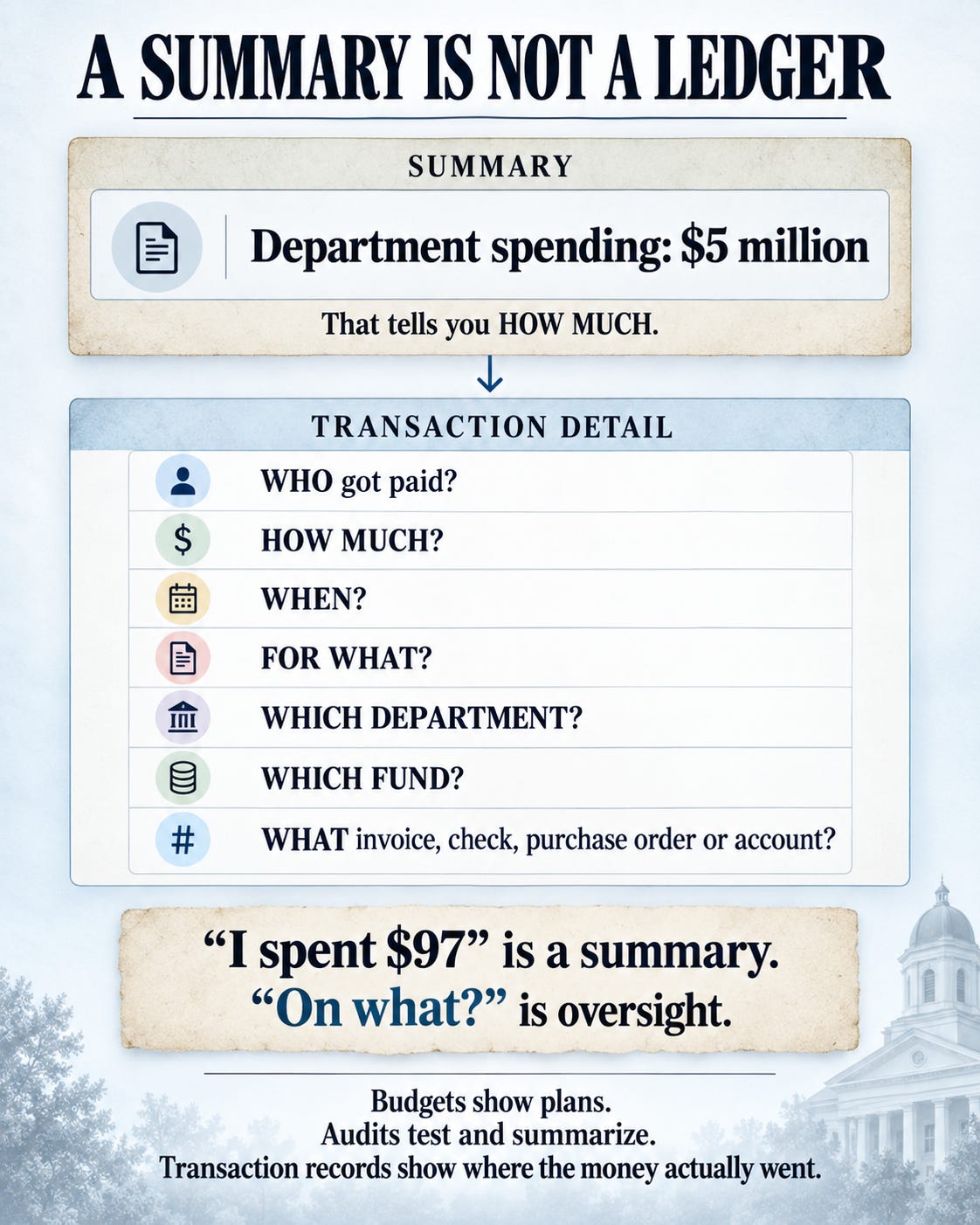
Who got paid? How much? When? For what? Which department paid it? Which fund? What invoice, check, purchase order or account was involved? That’s it.
A summary tells you a department spent $5 million. Transaction detail tells you where the $5 million went. If you hand a teenager $100 and he comes back with $3, “I spent $97” is technically a financial summary. You are still going to ask the next question.
On what?
Your bank does not send you a statement that says, “Good news, you spent $4,213 this month. Trust us.”
It lists the transactions.
Government should be held to at least the same expectations as somebody with a checking account or a teenager. Taxpayers should not lower standards because the spender has a county seal and doesn’t use an adding machine and typewriter anymore.
.The Commissioners Can’t See It Either
And here is where this gets much worse. From my reporting and conversations about Walker County’s financial process, the district commissioners themselves do not routinely receive a check-register-style breakdown showing individual county payments, vendors, amounts and invoice or check references.
The people elected to oversee county government, vote on budgets, approve taxes and set financial policy are largely working from summaries while the actual transactions sit underneath them in the accounting system.
The county would presumably answer that any commissioner can ask for the detail anytime. Undoubtedly true. But information you have to think to request is not oversight. It’s homework it is extra work. And that should concern people far more than whether Elliot Pierce got the run around trying to get records.
Walker County moved from its old sole-commissioner system to a five-member board in 2021. The point was to add representation, deliberation and oversight. But adding four commissioners does not automatically create four more layers of oversight if nobody routinely gives them the details.
Eyes are useful only if you let them see. A commissioner trying to monitor county finances from summary totals is like a mechanic diagnosing your engine by looking only at the fuel gauge. Maybe everything is fine. But he sure as hell doesn’t know from that gauge.
Other Georgia counties have somehow solved this technological riddle without assistance from NASA. Monroe County posts check registers online. Jasper County commissioners approve check registers in public meetings and publish them. Augusta offers a searchable check register where citizens can look up payments by payee, date, department and account. Countless others do this. Governments big and small.
Monroe County. Jasper County. Augusta. Fulton County. Chattanooga.
Walker County publishes budgets and audits, but no transaction level details. No comparable routine public check register or searchable vendor-payment ledger. That is not a technology or funding problem.
That is a choice.
And choices have authors.
Which brings us to Angie Teems.
Truth, Transparency, Accountability
Angie Teems did not run for office promising a less transparent Walker County. Quite the opposite. She centered her campaign around transparency. She campaigned around “Truth, Transparency, Accountability.”
I remember because I supported much of what she said she wanted to change. I wrote about it. We discussed it. I believed Walker County needed a government that treated citizens less like an audience and more like owners. That matters because I did not start with a grudge against Angie Teems and go hunting for evidence to support it. I started by believing the transparency promises. I started by believing in Angie Teems.
Campaign promises are not slogans and signs memorabilia you box up after inauguration. They are the standard the candidate volunteered to be judged against. And by that standard, Teems’ record is ugly. And even that is being kind.
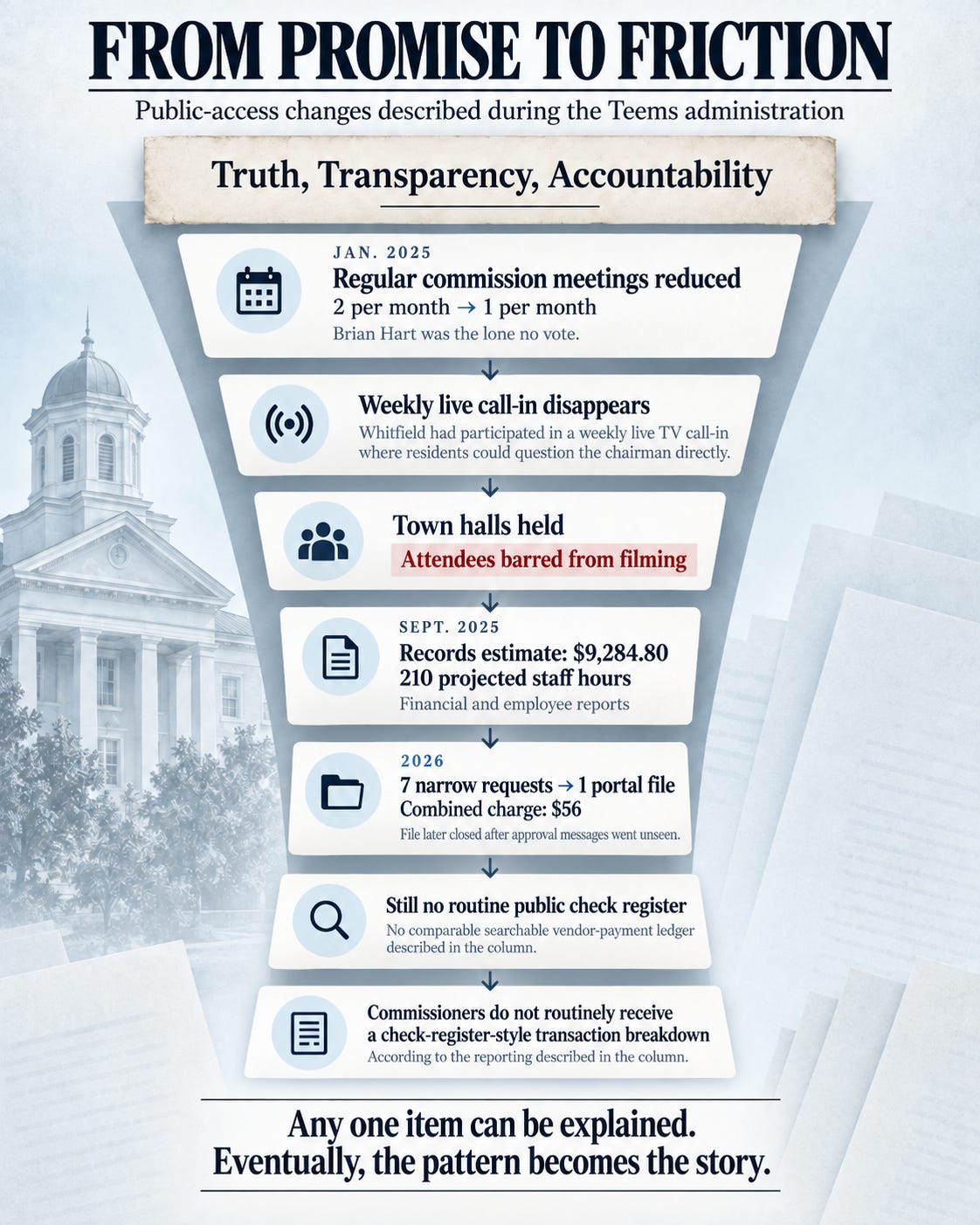
At her first Board of Commissioners meeting in January 2025, the board reduced regular meetings from twice a month to once a month. Brian Hart was the lone no vote. Teems has since held town hall meetings around the county, and I have credited her for doing so. But that deserves an asterisk that has become more relevant with time. Last year, Teems barred attendees from filming those town halls.
The charitable explanation is that cameras make some residents reluctant to speak. Maybe. But you do not make government more open by making it less recordable. Consider the contradiction. The administration reduces formal commission meetings, points to town halls as another avenue for public access, and then tells citizens they cannot record the town halls.
You can call that many things. “Transparency” would not be my first choice.
A town hall is not a Board of Commissioners meeting anyway. It carries no votes, no official agenda, no substitute for the public’s business being conducted in front of the public. But if you’re going to cite informal forums as evidence of openness, barring citizens from recording them rather spoils the point.
Teems’ predecessor, Shannon Whitfield, went considerably further in the other direction. He was even praised for it across the state. He sat for a weekly live television call-in program where residents could telephone in and question the chairman directly.
Those programs could be awkward. Sometimes painfully (or hilariously) so. Which was precisely why they had value for the public.
Live questions have an irritating quality for elected officials . . . they are live.
You cannot pre-screen them, workshop the wording, edit the exchange afterward or decide the topic would be better addressed next week in a county Facebook post.
Somebody calls. You answer.
That weekly live call-in disappeared when Teems took over. Now put the pieces together. Two regular commission meetings became one. The weekly live call-in disappeared. Town halls were offered as public-access events, but citizens and media were barred from filming them. A 2025 request for ordinary financial and personnel information generated a $9,284.80 estimate and 210 projected staff hours. Seven deliberately narrow financial requests were later bundled into third party vendor portal file, then closed after the third party emails were flagged as spam. The public still has no routine check register or record of disbursements. The commissioners themselves still do not routinely receive transaction-level details and revenue and spending across all funds.
Any one item can be explained. But taken together the picture is damning and the explanations become the story.
Facts Matter. Records Matter More.
Is information routinely published, or does somebody have to ask for it? When somebody asks, is the instinct to provide it or to explain why providing it is difficult? Are commissioners given enough information to scrutinize spending, or enough information to be reassured that spending is fine? Does “open government” mean citizens get access to the underlying records . . . or that officials tell citizens what those records supposedly mean?
That last distinction has become especially important because Walker County itself recently launched a series called “Facts Matter.” The county’s August installment on its finances begins with a rather remarkable declaration: “Citizens deserve accurate information from a knowledgeable source, so they can be an informed participant in their government. That is what we provide. Here are the facts concerning the county’s current financial health directly from the source itself, Walker County Government.”
Read that carefully. Citizens deserve information from a knowledgeable source. And that source is . . . the government being scrutinized. Well, yes. The county should explain its position. It should correct misinformation. It should publish facts.
But a government announcing “Facts Matter” and then presenting its own interpretation as the authoritative source is marketing and public relations.
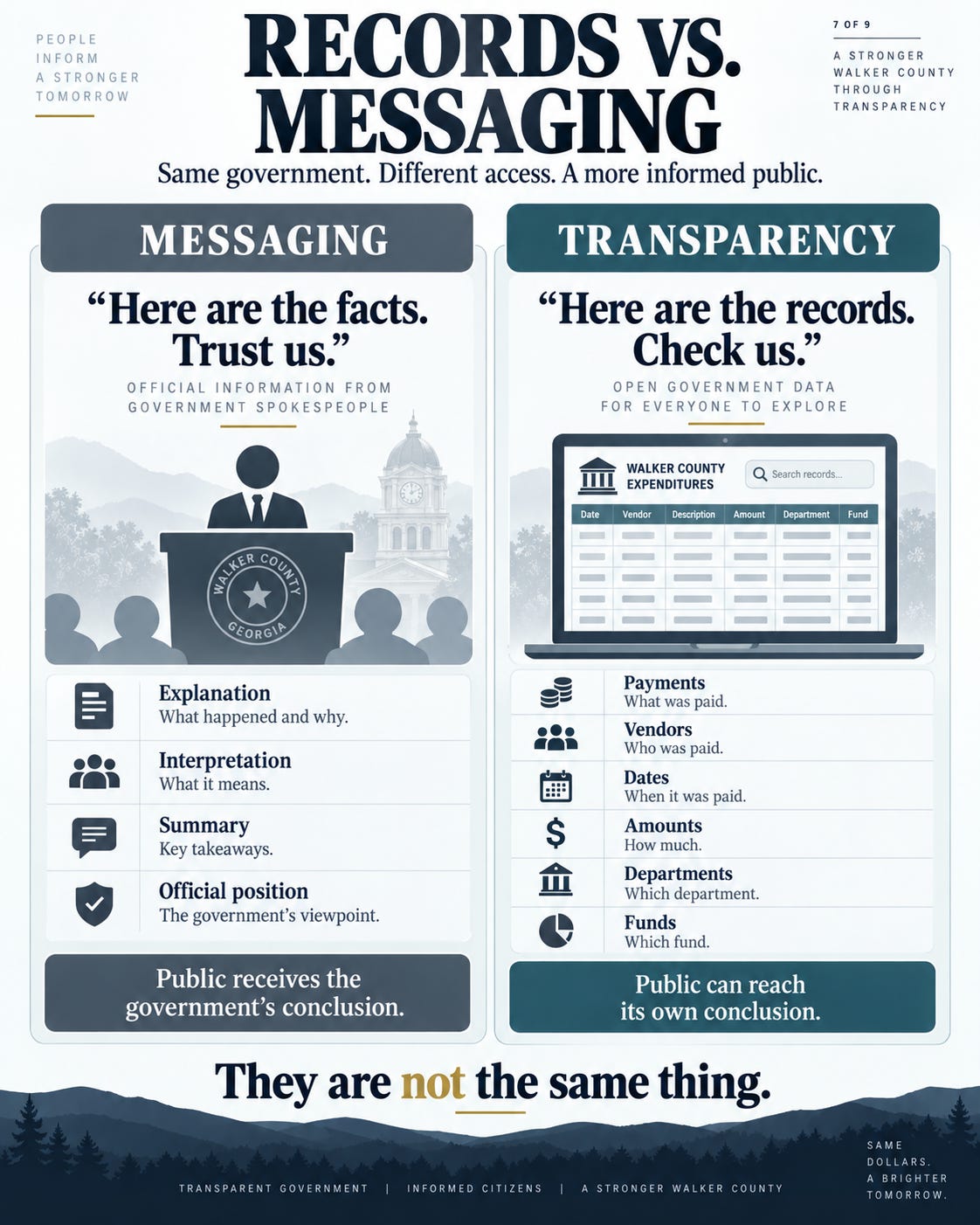
“Here are the records. Check us.” is transparency.
“Here are the facts. Trust us.” is not.
One asks the public to trust the government’s explanation. The other gives the public the means to verify it.
That is almost the perfect summary of Walker County’s transparency problem. The administration seems increasingly comfortable telling the public what it believes the public needs to know, while being much less enthusiastic about giving citizens the underlying financial detail necessary to reach conclusions of their own.
“Facts Matter” is a fine slogan. Records matter more.
Somewhere along the way, the burden has shifted backwards.
Government should begin with: this is the public’s money, so show the public where it went. Instead, the citizen begins with: I would like to see where my money went. Then comes the process. What exactly do you want? Which report? Which format? How much staff time? Did you approve the estimate? Did you check the portal? Did you check your spam folder? Transparency has become an obstacle course where taxpayers are expected to prove sufficient persistence to reach their own ledger. That’s backwards.
And none of this requires accusing anybody of stealing a dime. That is another reflex worth retiring. The purpose of financial transparency is not merely to catch corruption after somebody gets caught carrying a sack of cash out of the courthouse. Transparency matters before there is corruption, before there is waste, before an audit finding and before a scandal.
Transaction-level visibility is how somebody notices one vendor’s payments suddenly doubled. It is how a commissioner sees the same contractor appearing again and again. It is how a reporter spots a pattern, how a taxpayer notices an odd purchase and how officials discover that an innocent-looking account has quietly become expensive. Most government waste does not walk into a commission meeting wearing a name tag that says WASTE. It hides in repetition: one payment, another payment, the same vendor, the same account, another invoice, another exception, another explanation.
And transparency protects competent government too. If Walker County is spending responsibly, publish the transactions. If critics are wrong, prove them wrong with the records. If commissioners are exercising meaningful oversight, give them the information to demonstrate it. Secrecy does not protect competent government. It protects government from having to demonstrate competence.
This is also why the issue should not become some tribal referendum on Angie Teems personally. If you voted for her, fine. If you still support her, fine. If you believe her administration has done good things elsewhere, say so. But supporting an elected official should never require lowering the standard applied to the office . . . especially when that official campaigned on raising it.
State Reps. Mike Cameron and Steve Tarvin announced in August that they plan to introduce Walker County-specific legislation in the 2027 session requiring a forensic audit during the first year of each new commission chairman’s term, plus public disclosure, with a corrective action plan, whenever quarterly budgets run negative. We can argue about the particulars when there is actual bill language. But when state legislators are proposing special financial-oversight requirements for one county, perhaps the transparency problem has moved beyond one columnist being difficult.
The Fix Is 77 Years Old
The county’s worst response now would be another explanation. The better response is embarrassingly simple. Publish a monthly check register. Publish Accounts Payable. Publish outstanding encumbrances. Give every commissioner a meaningful transaction-level report each month and post the public version online. Make the data searchable and downloadable rather than embalmed inside giant PDFs. Let taxpayers search vendors, departments, dates and amounts without beginning a bureaucratic correspondence.
It would even make life easier for county employees. Every report and dataset proactively published is one less request somebody has to receive, route, estimate, retrieve, upload, track and eventually close. Transparency can reduce bureaucracy. Imagine that.
Then formal records requests can return to what they ought to be used for: unusual or specific records. Not a test of persistence to see the county ledger.
And the most embarrassing part for Walker County is that none of this is a new idea. The county understood it in 1949. There it is on a newspaper page . . . $9.45 for pots, pans, spoons and cups. $13.52 for axes. $40 to publish the financial report itself. And one dollar for post-office box rent.
Walker County thought that one dollar belonged in the public accounting because it was public money. That principle did not become obsolete when computers arrived.
If Walker County could account to taxpayers for a one-dollar post-office box 77 years ago, it can account for every public dollar today.
Not doing so is a choice.