


There is an old saying that you cannot escape death or taxes. Apparently, you cannot escape taxes by calling them fees, either.
That was essentially the message delivered by the Georgia Supreme Court on October 14, when it ruled that Chatham County’s method of charging property owners for fire protection was illegal.
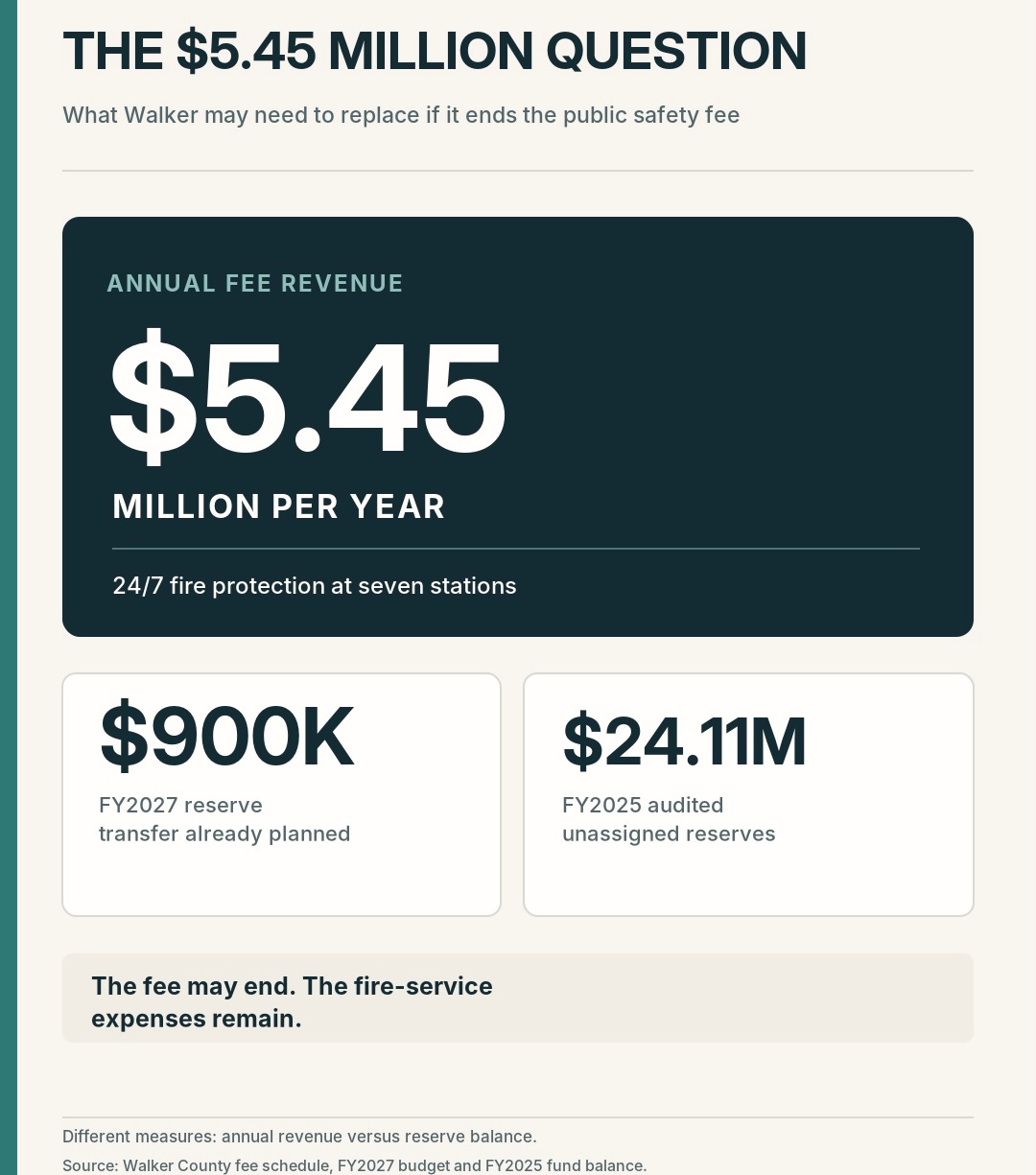
The decision came out of a lawsuit in southeast Georgia, but its consequences are now headed straight for Walker County, where local officials have been using a remarkably similar arrangement to collect approximately $5.45 million annually.
And if you thought the county’s budget problems were settled when commissioners adopted their new budget last month, I have some unfortunate news.
We may have just finished the warm-up act.
The county now faces the possibility of losing millions in annual revenue, confronting demands for refunds of money collected in previous years, and figuring out how to pay for fire protection without using a funding mechanism that the state’s highest court has just rejected.
All while trying to avoid an enormous property tax increase.
To understand how we got here, we first need to understand what the court actually decided. For more visit: firefees.elliotpierce.net
For years, local governments around Georgia have used special fees to pay for services that otherwise might require higher property taxes.
The concept is fairly straightforward. Instead of raising the property tax rate, counties charge property owners a separate fee dedicated to a particular service.
In Walker County, that service is primarily fire protection.
The county established its Fire and Rescue Special Tax District in 1994. Today, property owners in the covered areas, including unincorporated Walker County and Chickamauga, pay a public safety fee based largely on the square footage of their buildings.
Under the current schedule, adopted in 2023, the charge is 14 cents per square foot, with residential minimum and maximum charges of $125 and $600.
Own a 2,000-square-foot house? That works out to $280 annually.
The money helps operate seven fire stations around the clock.
The appeal to local governments is obvious. A fee provides dedicated revenue without requiring the politically unpleasant business of raising the property tax millage rate.
For readers unfamiliar with the term, the millage rate determines how much property tax you pay based on your property’s taxable value.
Calling something a fee rather than a tax may seem like a technical distinction, but the distinction matters considerably under Georgia law.
And that is precisely where Chatham County ran into trouble.
In Chatham County v. Smith, property owners challenged a fire protection charge that, much like Walker County’s, was calculated using building square footage rather than property value.
The county argued that it was collecting a fee to provide fire protection, not imposing a property tax.
The Supreme Court disagreed.
The justices concluded that because the charge was mandatory, tied to property ownership, and used to finance a government service available regardless of whether an individual property owner actually used it, the charge was a tax.
And under Georgia law, a tax imposed on real property generally must be based on the property’s value.
That is what lawyers call an ad valorem tax.
A charge based on square footage instead of value does not satisfy that requirement merely because county officials decided to call it something else.
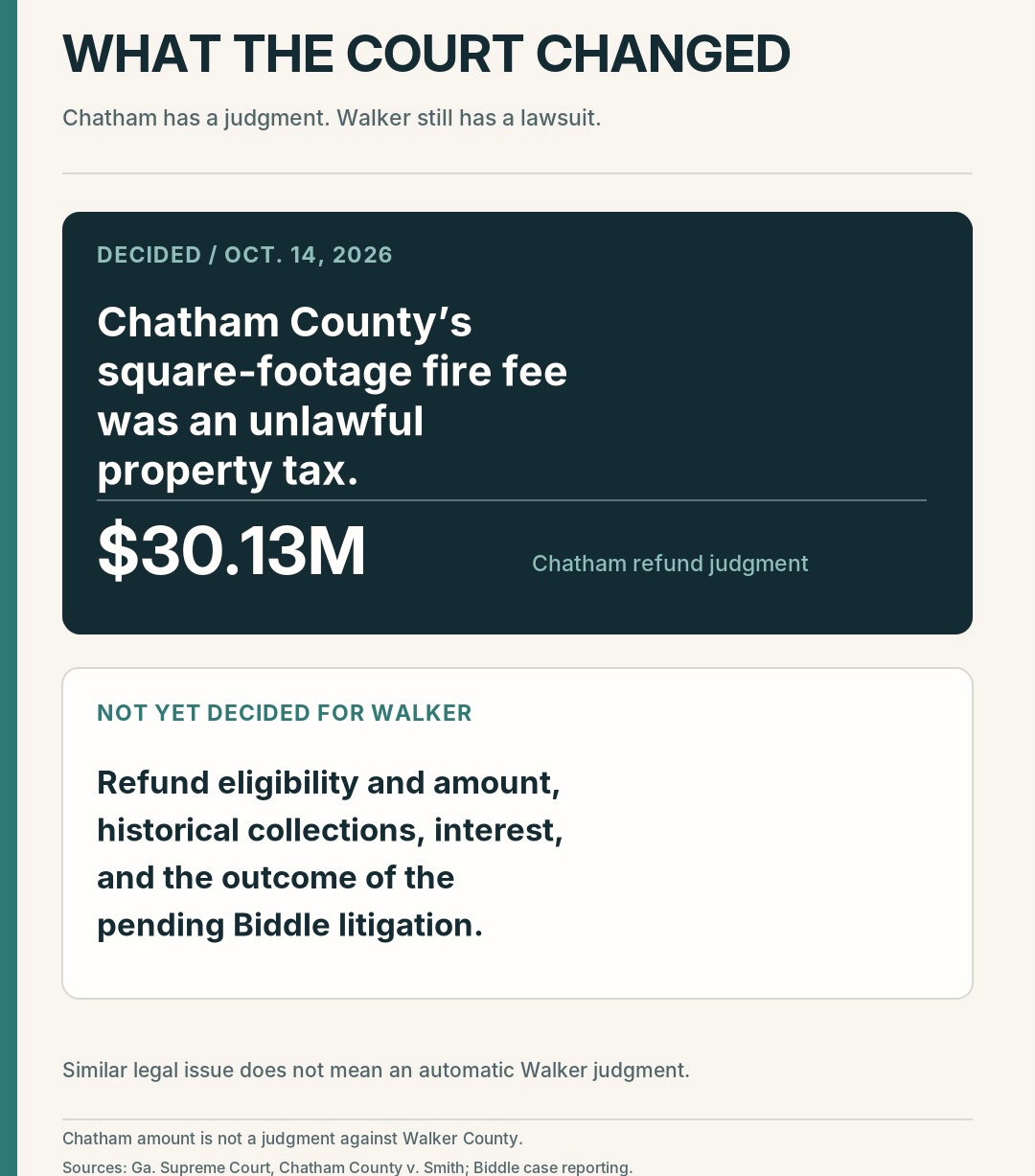
The court affirmed a judgment requiring Chatham County to refund approximately $26.85 million in improperly collected fees, plus another $3.27 million in interest.
More than $30 million altogether.
That is an expensive lesson in the difference between a fee and a tax.
And Walker County has a particular reason to be paying attention.
The county is already being sued over its own public safety fee.
In 2024, Walker County property owners Michael Biddle, Jessica Allison and Waylon Allison filed a proposed class-action lawsuit challenging the legality of the county’s public safety fee.
Their argument is substantially similar to the one that succeeded in Chatham County.
They contend that Walker County’s charge is not a legitimate fee for an individually provided service, but an improperly imposed property tax used to finance general fire protection and emergency services.
The Walker County case, commonly referred to as the Biddle case, had been stayed while the Georgia Supreme Court considered the Chatham litigation.
Now that the justices have ruled, the legal landscape has changed considerably.
To be clear, the Supreme Court did not directly rule on Walker County’s ordinance. The Biddle case must still proceed through the courts, and questions about refunds and the extent of any liability remain unresolved.
But the similarities between the two funding arrangements are impossible to ignore.
Both involve mandatory charges imposed on property owners. Both use building square footage to determine the amount owed. Both finance fire protection that is generally available throughout the applicable service area.
The prospect of continuing to collect the same fee while defending its legality has become considerably more complicated.
Which brings us to the question that should concern every Walker County taxpayer.
What happens when $5.45 million disappears from the budget?
Firefighters still need salaries, equipment must be maintained, and stations must remain operational. The county cannot simply eliminate the fee and pretend the expenses it paid for have disappeared.
One option would be to replace the entire amount with property taxes.
That would mean increasing the millage rate enough to generate approximately $5.45 million in additional annual revenue, potentially through a dedicated fire-service tax district.
In purely mathematical terms, it is the simplest solution.
Politically, it is another matter.
Walker County commissioners spent much of this summer wrestling with a budget shortfall and the possibility of raising property taxes.
At one point, officials were attempting to close an approximately $1.9 million gap in the proposed budget for fiscal year 2027.
The county had already reduced department spending requests by more than $10 million, and additional reductions and revenue options remained under consideration.
Ultimately, commissioners adopted a $39.9 million budget on September 3 without increasing the property tax millage rate.
Instead, they approved a full millage rollback and used $900,000 from the county’s fund balance to help balance the budget.
The fund balance is essentially the county’s savings account, although not every dollar is necessarily available for every purpose.
That decision allowed commissioners to get through another budget season without a property tax increase.
Now, barely six weeks later, they are facing a potential revenue problem several times larger than the one they just resolved.
A one-time property tax increase large enough to replace the entire public safety fee would be a substantial political and financial undertaking.
Remember, the county’s existing property tax rate for unincorporated areas is only 5.005 mills.
Generating another $5.45 million from the properties served by the fire district could require a dramatic increase in that rate.
There is an important qualification here. Eliminating the existing fee would offset some or all of the additional property taxes for certain property owners. Others, particularly those with higher taxable property values, could end up paying considerably more.
The burden would shift from a system based largely on building size to one based on property value.
So a large percentage increase in the millage rate would not automatically mean every property owner’s total county tax bill increases by the same percentage.o

Nevertheless, I have a difficult time imagining commissioners embracing a massive, single-year millage increase after spending much of 2026 trying to avoid a considerably smaller one.
Which makes another approach seem far more plausible.
Use some of the county’s reserves, reduce spending throughout county government, and gradually transition fire protection funding to property taxes.
Walker County is not without financial resources.
According to its most recent audit, the county ended fiscal year 2025 with approximately $24.1 million in unassigned fund balance.
That is a substantial reserve for a county of Walker’s size.
Of course, it is not $24 million sitting around with a sign reading “Free Money.” The county needs reserves for emergencies, unexpected expenses, economic downturns and other financial obligations.
And the possibility of having to refund previously collected public safety fees makes maintaining adequate reserves especially important.
Still, there is a difference between responsibly using savings to manage a temporary financial disruption and recklessly spending them to avoid making difficult decisions.
The public safety fee ruling is precisely the type of extraordinary event that warrants examining whether reserves could help finance a transition.
Consider a hypothetical three-year plan.
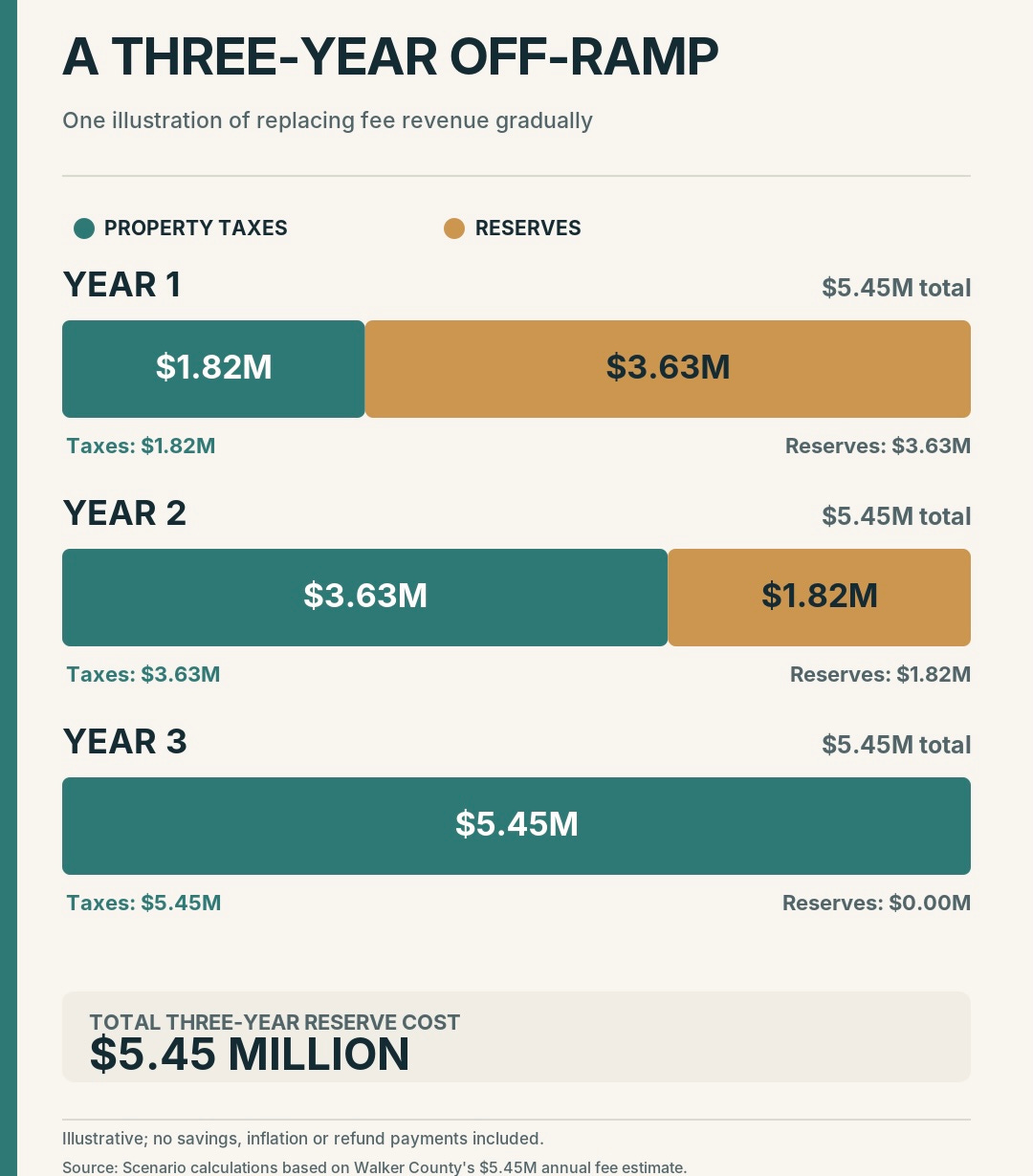
Instead of replacing all $5.45 million with property taxes at once, the county could replace approximately one-third of the revenue in the first year, another third in the second, and the final third in the third.
That would require approximately $1.82 million in additional recurring property tax revenue each year until the fee was fully replaced.
To cover the difference, the county would need roughly $3.63 million from reserves in the first year and another $1.82 million in the second.
By the third year, the entire amount would be funded through property taxes.
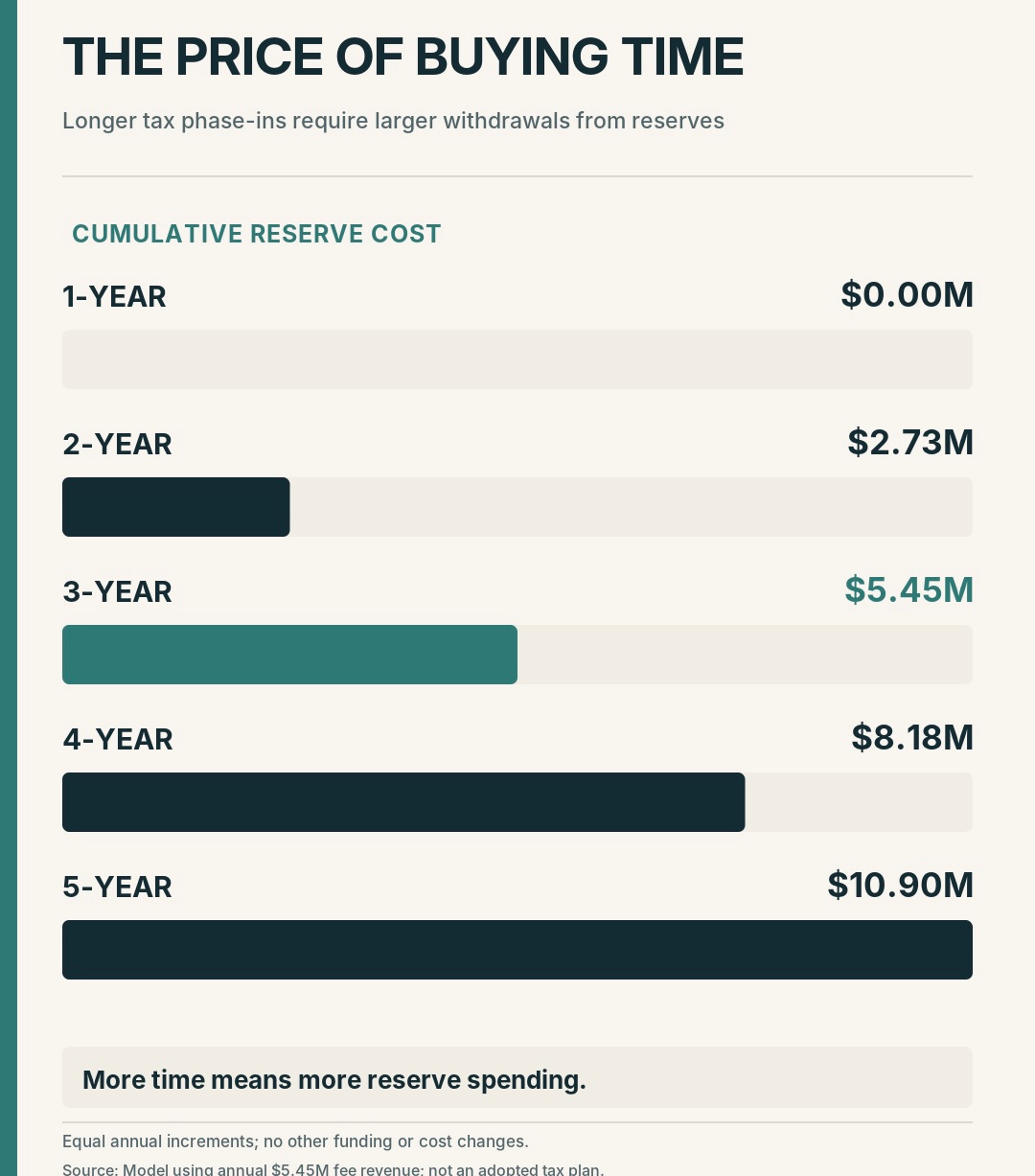
The total reserve cost of that transition would be approximately $5.45 million, assuming expenses remained unchanged.
That is hardly pocket change. But it illustrates how commissioners could avoid concentrating the entire tax adjustment into one year.
A four-year transition would reduce the annual increase further, although it would consume approximately $8.18 million in reserves.
A five-year transition would require nearly $10.9 million.
And that is before considering any money already being drawn from reserves or potentially needed to resolve the Biddle lawsuit.
The longer the transition, the more expensive the temporary relief becomes.
Which is why simply spreading a tax increase over several years is only part of the equation.
The other part is reducing how much money must be replaced in the first place.
That means going back through the county budget and identifying expenditures that can be reduced, deferred, eliminated or financed differently.
And unlike the usual political promise to eliminate waste, this would require finding actual dollars.
Commissioners could examine staffing vacancies, postpone certain purchases, reconsider planned expansions, renegotiate contracts, reduce discretionary spending and identify opportunities to consolidate administrative functions.
They could also revisit cost-sharing agreements with municipalities for services such as E-911 and animal shelter operations, options already discussed during this year’s budget process.
Some reductions might be temporary. Others would need to be permanent.
Suppose the county could find $1 million in sustainable annual savings or other legally available recurring revenue.
Suddenly, it would not need to replace $5.45 million through property taxes.
It would need to replace $4.45 million.
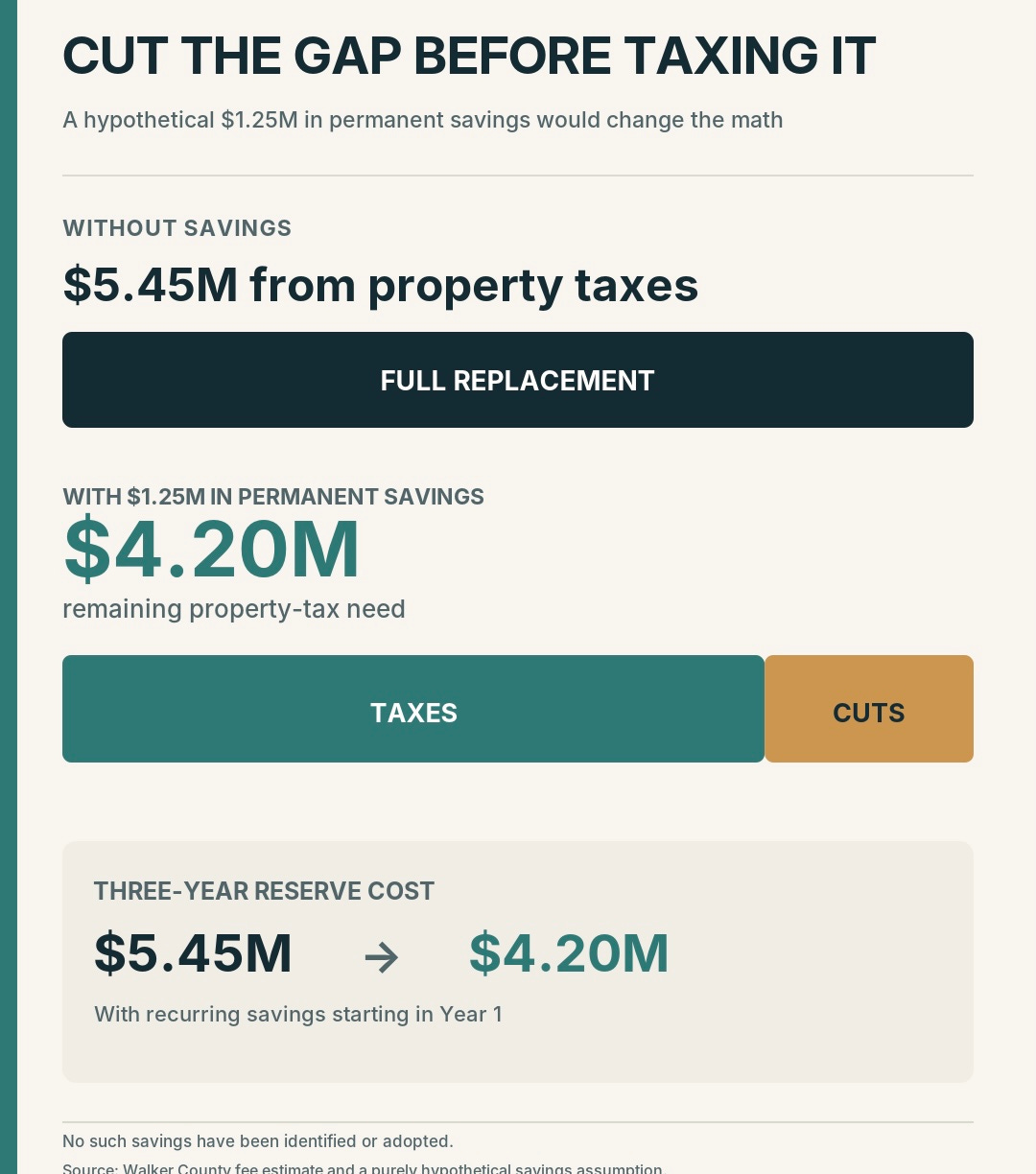
Combine those savings with a three-year transition and the required reserve withdrawals become smaller as well.
This is why broad budget reductions, combined with limited use of reserves and gradual property tax adjustments, seem more plausible than immediately replacing the entire fee with a single millage increase.
That does not mean finding the savings will be easy.
The county already spent months reducing department requests before adopting its current budget. Another round of cuts would involve real choices, some of which could affect services residents actually use.
It is easy to demand spending cuts in the abstract. It becomes considerably harder when the discussion turns to road maintenance, employee compensation, emergency response or other specific programs.
And cutting fire protection itself to solve a fire-funding problem would deserve particularly careful scrutiny.
There are also legal restrictions governing how money can be used to finance services benefiting particular areas of the county. Any replacement funding arrangement must respect those boundaries rather than simply shifting the costs onto taxpayers outside the affected fire district.
That is part of the problem the Supreme Court’s decision makes impossible to ignore.
There is also a second bill that could eventually come due.
Replacing future fee revenue is one problem.
Potentially refunding years of previous collections is another.
In Chatham County, property owners prevailed in recovering two years of challenged fees, with interest.
The Biddle lawsuit raises questions about Walker County’s historical collections, but no equivalent refund judgment has been entered against Walker.
The county’s potential liability will depend on how that litigation proceeds, what collections are legally recoverable, and what defenses remain available.
Still, commissioners cannot responsibly discuss spending millions from reserves without considering the possibility that those same reserves may be needed to resolve the lawsuit.
It would be rather unfortunate to spend the county’s savings replacing a questionable tax, only to discover those savings are needed to repay the questionable tax.
There is also a timing problem.
The current county budget began October 1. The Supreme Court issued its decision October 14.
Any replacement property taxes adopted during the 2027 tax-setting process would generally arrive during the following county fiscal year.
Depending on what happens to current fee collections, the county may need temporary funding before a new property tax arrangement can even begin producing revenue.
That makes the financial situation more complicated than merely adjusting next year’s millage rate.
And it is another reason commissioners need to begin discussing the problem publicly rather than treating it as a distant legal question.
For nearly three decades, Walker County has relied on a special funding arrangement to support fire protection.
Whatever the original intentions, the Georgia Supreme Court has now made clear that local governments cannot simply substitute a mandatory, property-based charge for a legally authorized property tax.
The county’s obligation to provide essential services remains. So does the obligation to pay for them lawfully.
There are no painless solutions here.
An immediate tax increase could preserve reserves but produce a substantial adjustment for property owners. A multiyear transition could soften the impact but consume millions in savings. Spending reductions could reduce the amount taxpayers must replace, but would require county officials to make unpopular decisions about expenditures.
Most likely, the eventual response will involve some combination of all three.
And the solution must account for the Biddle litigation, rather than spending money today that might be needed to settle yesterday’s collections.
For taxpayers, the question is no longer simply whether the public safety fee was a good idea.
The Supreme Court has answered the more consequential question of whether a government can use this type of charge in place of a lawful property tax.
Now Walker County must figure out what comes next.
The fee may be going away. The cost of government isn’t.
And after years of treating the two as different things, county officials may finally have to explain to taxpayers exactly how much fire protection costs, where the money goes, and what they are willing to cut before asking for more.
That is a conversation Walker County should have been having all along.