


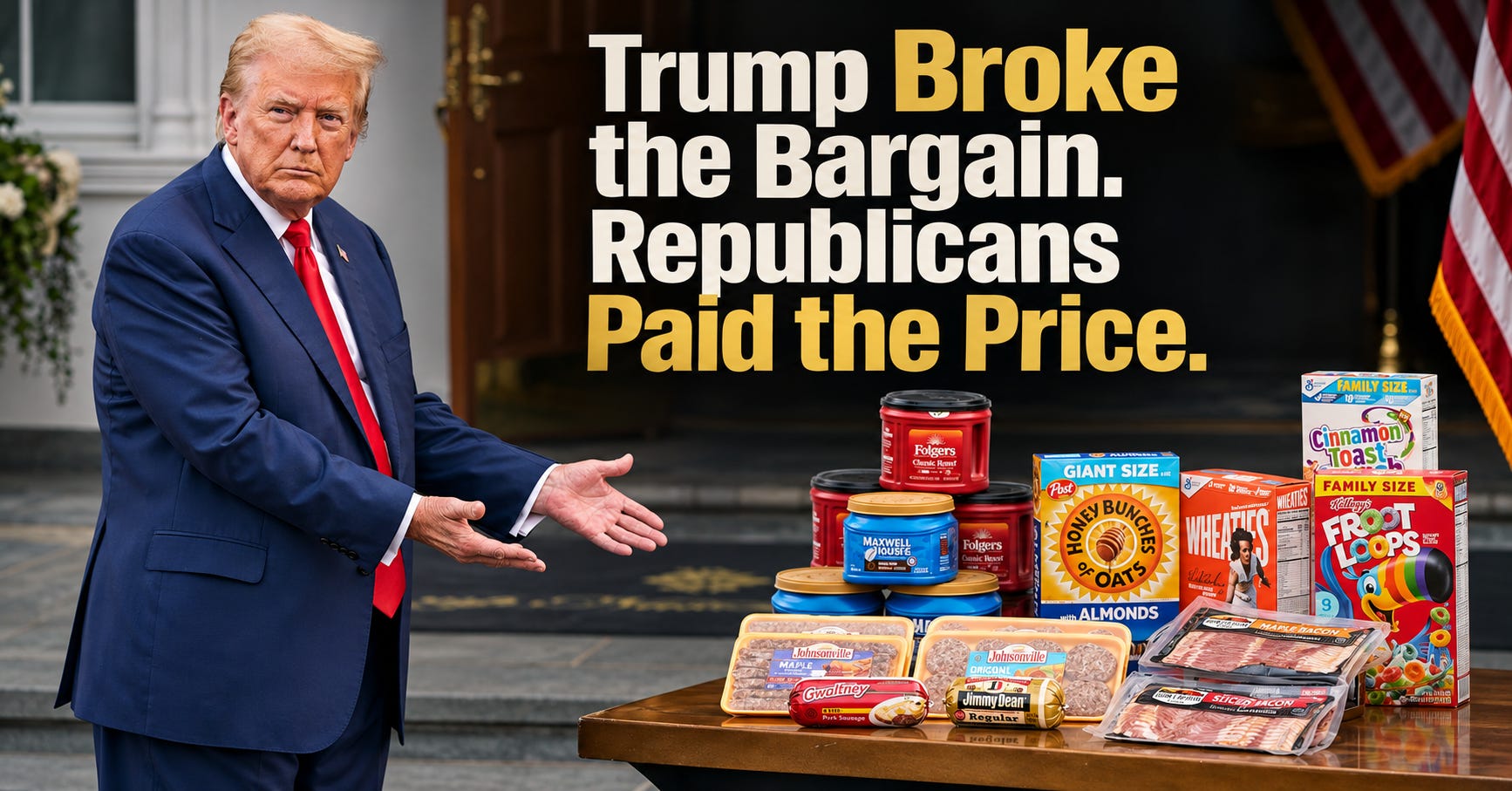
In August 2024, Donald Trump held a press conference at his Bedminster golf club surrounded by groceries. Bacon, coffee, cereal, and enough household staples to stock a small convenience store. Spotting the Cheerios, he joked that he hadn’t seen them in a long time.
Classic Trump. Funny, a little ridiculous, but effective.
Trump has an extraordinary gift for connecting with people. His humor, charisma, and irreverence have attracted millions who wouldn’t ordinarily give a Republican politician the time of day. He is a political talent we are likely to never see again.
That afternoon, surrounded by breakfast groceries, he promised relief.
“I will immediately bring prices down,” he declared. He went further, promising to cut energy and electricity prices by at least half within a year.
Five months later, during his inaugural address, Trump repeated his promise to lower prices, blamed excessive government spending for inflation, and declared that his proudest legacy would be that of a “peacemaker and unifier.”
Millions believed him.
Tuesday’s midterm election results revealed that a great many have since reconsidered.
Democrats captured both chambers of Congress. But it is hard to overstate the near comprehensive nature of this disaster for Republicans. Tuesday’s defeats for Republicans went far beyond Capitol Hill. In Texas, Gina Hinojosa ousted incumbent Greg Abbott by seven points and Democrats captured the state House, ending thirty years of unified GOP control in Texas overnight. Georgia saw a total executive wipeout, with Keisha Lance Bottoms winning the governorship at 54.3% to anchor a sweep of every statewide constitutional office on the ballot. The trend continued across the country. Of the 10 most populous US states, only Florida will be in Republican control come January.
And The near-misses in deep red areas were just as damning. Byron Donalds barely survived to become Florida’s next governor with a 1 point win. Tommy Tuberville was held to a four-point squeaker in Alabama against Doug Jones, and Marsha Blackburn hung onto Tennessee’s governorship with a meager 45.5% plurality. And Louisiana nearly sent a Democrat to the senate! Across the country, Republicans lost competitive districts and suffered defeats in places Trump had carried comfortably two years earlier.
The Democrats certainly didn’t suddenly become tye darling of voters. Americans remain dissatisfied with both parties. But Republicans would be foolish to explain away the results as merely a turnout problem or a collection of unfortunate candidates.
Trump was the party’s message, its organizing principle, and increasingly its test of loyalty. Voters knew whom they were judging.
His devoted MAGA base was never the entire coalition that elected him in 2024. Trump also won over independents, working-class Americans, younger voters, and disaffected libertarians and conservatives who were willing to overlook his personal shortcomings and the drama because they expected something better.
They wanted affordable groceries and housing, secure borders, less government , and an end to Washington’s appetite for expensive foreign adventures.
They made a bargain with Trump. They would tolerate the personality and the political circus if he delivered.
The evidence that he lost their confidence had been accumulating for months.
An October Pew Research Center survey found Trump’s approval at just 30%. Among his own 2024 voters, approval had fallen from 95% early in his second term to 67%. Among those supporters ages 19 to 34, it was down to 49%.
Nearly a third of his own 2024 voters had soured on his performance.
Trump hadn’t suddenly lost blue dog Democrats. He never had them. He was losing the people who had given him another chance.
And their complaints were easy enough to understand.
Consumer prices were still rising 3.7% annually in September. Gasoline prices had jumped 34.2% over the preceding year. Electricity was up another 4.4%. Housing remained out of reach for millions of families.
Compare those numbers with the promises made beside the Cheerios.
Yet, by December 2025, Trump was dismissing affordability as a Democratic “con job.”
The always perceptive Newt Gingrich recognized the danger in this. “Any Republican who refuses to admit we have an affordability problem is not listening to the American people,” the former House speaker warned.
Gingrich understood something Trump seemed increasingly unwilling to accept. Americans don’t judge their finances by presidential declarations that all is well. They judge them by the money remaining after the bills are paid.
Gingrich went further, observing that Americans, rather than politicians, get to define their economic reality. He understood the political trap. Biden and Harris had spent years reciting favorable economic statistics while voters stared at their bills. Trump exploited that disconnect brilliantly in 2024, then inexplicably proceeded to repeat it himself.
Worse, the gaslighting became almost insulting.
Americans knew what groceries cost. They knew their mortgage payments, insurance premiums, and credit-card balances. Yet the president who had promised relief increasingly treated their complaints as political fabrications.
A politician can survive mistakes. Voters regularly forgive bad decisions and unmet promises. What is far more difficult to survive is convincing voters that their concerns are not being heard, or worse, that the concerns themselves are illegitimate.
A president can survive disappointing economic results. Convincing people that their financial problems aren’t real when they can count them in dollars is a considerably tougher proposition.
And some of Trump’s policies were making those problems worse.
Tariffs were a campaign promise, and he kept it. But tariffs are taxes collected from American importers, with much of the cost ultimately falling on domestic businesses and consumers. Research from the Federal Reserve Bank of New York found that American firms and consumers bore nearly 90% of the economic burden of the tariffs imposed during 2025.
For working-class families, that’s effectively another sales tax, conveniently disguised as economic patriotism.
The factory worker supposedly benefiting from protectionism also buys tires, appliances, clothes, and tools. Higher prices don’t become less painful because somebody in Washington wraps them in an American flag.
Meanwhile, Washington kept spending.
During fiscal 2026, the federal government collected $5.4 trillion and spent $7.4 trillion. The deficit approached $2 trillion, up more than $200 billion from the previous year.
Persistent government borrowing adds pressure to credit markets and can make private financing more expensive. It’s hardly the only reason mortgages and auto loans remain costly, but federal deficits of this magnitude certainly don’t help.
Which brings us to DOGE.
Remember DOGE?
For a few months, it looked as if Republicans might finally confront Washington’s spending addiction and leviathan federal government. Elon Musk challenged questionable contracts, exposed waste, and generated genuine excitement among many Americans who had waited decades for someone to take government efficiency and waste seriously.
Then came the astroturfed protests, hostile media coverage, corporate backlash.
Congressional GOP leaders had a choice. They could defend worthwhile reforms, correct the errors, and turn the findings into legislation.
Instead, the enthusiasm faded almost as quickly as it had arrived as congressional republicans caved.
Speaker Mike Johnson promised Congress would codify DOGE’s changes. Republicans eventually approved roughly $9 billion in rescissions, real money but barely 0.12% of annual federal spending.
The larger legislative effort never materialized.
The Department of Education saga offered an equally revealing example.
Trump promised to abolish it and return education authority to the states. He signed an executive order directing its dismantling. Republican lawmakers introduced legislation to eliminate the department.
Neither chamber brought those bills to a floor vote.
Republicans controlled Washington and couldn’t even manage a serious legislative confrontation over one of their longest-standing promises. Even if Senate Democrats ultimately blocked the legislation, Republicans could have made their case, forced a vote, and demonstrated that they were serious.
All the executive orders made excellent television. Permanent structural reforms required the considerably less glamorous work of Congress.
The President and Republican leaders seemed to prefer the television.
But the broken promises extended well beyond economics and government efficiency.
During his inauguration, Trump declared that his administration would be judged partly by the “wars we never get into.”
He called himself a peacemaker.
That promise mattered to war-weary conservatives, younger voters, and Americans who had grown tired of sending soldiers and money into Middle Eastern conflicts with no convincing justification, much less any explanation of how they would end.
Then came military strikes against Iran in June 2025, followed by a much larger war beginning in February 2026. There are serious national-security arguments concerning Iran, and presidents sometimes face threats they had hoped to avoid.
But Americans who supported Trump because they believed he would keep the country out of another costly foreve war had every reason to question what happened to the peacemaker.
The financial consequences of the Iran War have been immense. The president who promised cheaper energy was presiding over a war that helped rapidly make energy more expensive.
Then there was Epstein and transparency.
During the 2024 campaign, Trump expressed a willingness to release the government’s Epstein files. His campaign circulated the remarks, and his administration subsequently encouraged expectations of greater transparency across government.
In February 2025, Attorney General Pam Bondi suggested an Epstein client list was available for review. The Justice Department distributed binders of largely previously public material and promised more.
By July, the department and FBI announced that they had found no incriminating client list and declared that further disclosure was unwarranted.
The reversal infuriated many of Trump’s most loyal supporters.
Rather than acknowledge that his administration had encouraged expectations it couldn’t satisfy, Trump attacked people demanding answers. He dismissed the controversy as a hoax and accused disgruntled supporters of doing the Democrats’ work.
Congress eventually passed legislation requiring disclosure, which Trump signed in November 2025 after he essentially had no choice. The Justice Department released approximately 3.5 million pages by January 2026. Less than half.
That eventual disclosure matters. It doesn’t erase the earlier reversal or the spectacle of a president ridiculing supporters for simply expecting the transparency his administration had promised.
The question was whether government officials would provide candid answers and handle public records as openly as they had promised.
An administration elected partly to expose Washington’s secrets had managed to turn transparency into another public-relations disaster. And in the process, Trump revealed something about his increasingly defensive relationship with his own supporters.
He had once encouraged Americans to challenge Washington’s official narratives. Now he seemed to expect them to accept his.
To be fair, Trump delivered meaningful results on border enforcement. Crossings fell dramatically after he returned to office, and he deserves credit for effectively pursuing a policy voters clearly wanted.
But success on immigration didn’t erase disappointment over affordability, federal spending, foreign policy, or transparency.
His most devoted supporters could overlook those contradictions. The broader electorate was less forgiving.
Then came Tuesday.
For weeks, Trump had instructed Republicans to pretend he was personally on the ballot. On October 31, he told supporters exactly that: “Pretend that I’m on the ballot.”
When the returns turned disastrous, Trump insisted Republicans would have won in a landslide if he had actually been running. Apparently, the election was a referendum on Trump until the voters rendered their verdict.
Then it became somebody else’s problem.
That response neatly captured the arrogance and gaslighting that had compounded the administration’s failures. Trump increasingly behaved as though the people who elected him owed him their loyalty regardless of what he delivered.
They didn’t.
Republicans now face an uncomfortable choice with President Trump now a lame duck.
They can blame the media, complain about turnout, question the loyalty of disappointed voters, and continue treating Trump’s political interests as synonymous with the party’s future.
Or they can acknowledge that the Republican Party has drifted away from both the principles it claims to represent and the practical concerns of the people it needs to win.
That doesn’t mean moving left or adopting a more moderate variation of the same big-government progressive policies.
It means recovering a governing philosophy capable of producing the results Americans were promised.
Fiscal restraint. Less unnecessary government interference. Greater economic competition. More affordable housing and energy. More opportunity for private enterprise. Greater respect for constitutional limits on government power.
And perhaps most importantly, a willingness to tell voters the truth, including when the truth is politically inconvenient.
Americans aren’t clamoring for lectures about laissez-faire economics or constitutional theory. They want the prosperity, opportunity, and freedom that conservative principles are supposed to help produce. The party cannot continue promising those results while abandoning the principles that might deliver them.
Trump’s broken promises created disappointment. His unwillingness to acknowledge the failures turned disappointment into resentment. Congressional Republicans’ unquestioning loyalty ensured that the consequences reached far beyond the White House.
Trump understood something important when he stood beside those groceries in August 2024.
He knew ordinary Americans cared more about the price of breakfast than whatever political argument was consuming Washington that week. His humor and charm convinced millions that he understood their problems.
But families still have to buy groceries after the cameras and campaigns leave. The bills keep coming. And voters eventually expect the man who promised to make things better to deliver.
Trump knew why the price of groceries mattered when he needed their votes.
Somewhere between the 2024 campaign and the White House, he stopped listening and speaking to the people buying them. And that is why Tuesday happened.