


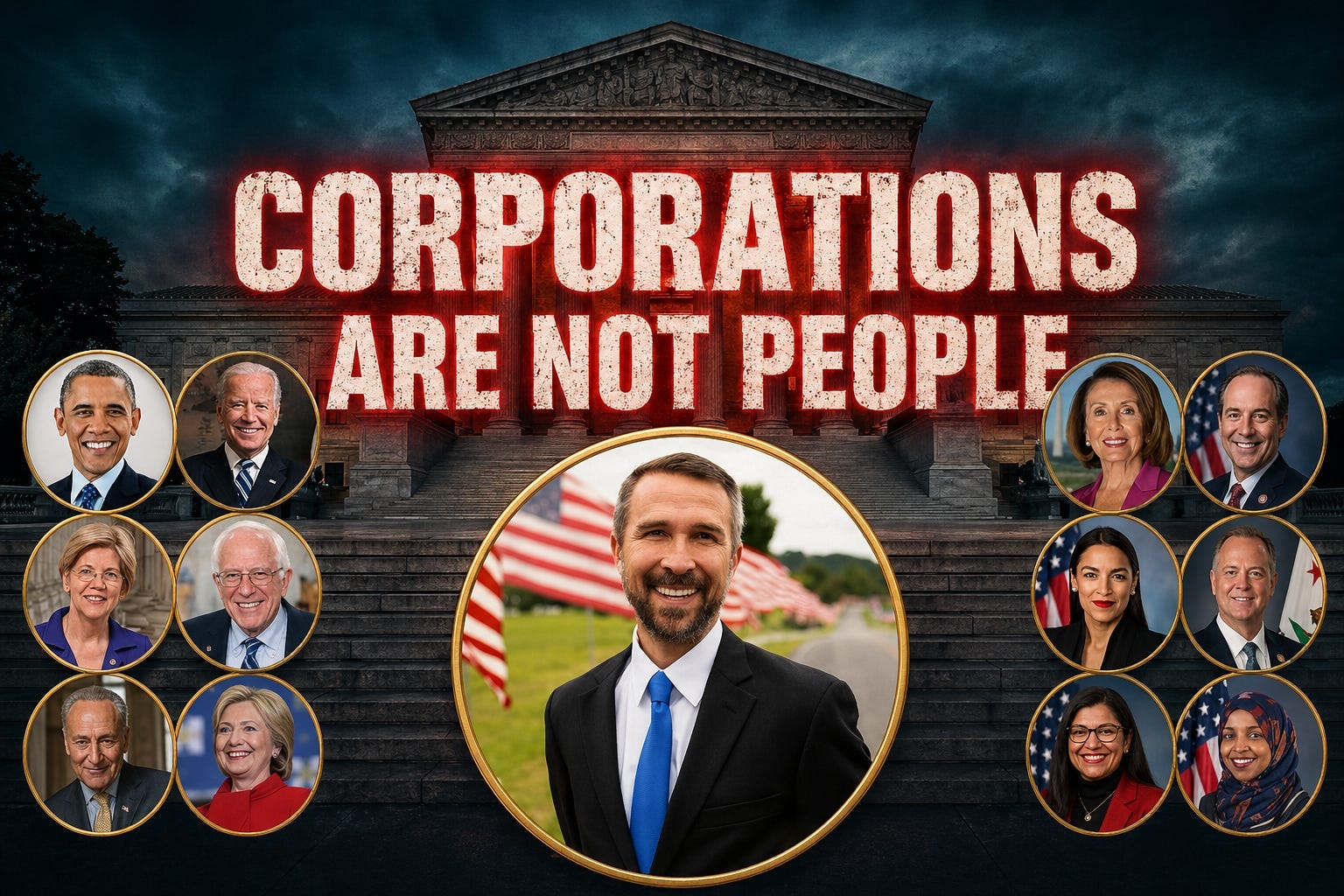
At the end of April at a meet the candidate event in Ringgold, someone at the event asked Nick Millwood what he thinks about the Supreme Court’s Citizens United decision.
The most revealing words he said during the entire event were. “Corporations aren’t people.”
Stop right there.
Does that sound familiar?
It should. You have almost surely heard that line before. From Late night talk shows, from Jon Stewart bits on the Daily Show, from Cable news. T-shirts at protests. Tik Toks and memes too. Hillary Clinton said it constantly in 2016 and ran on a promise to put justices on the Supreme Court who would overturn Citizens United. Bernie Sanders said it louder. Elizabeth Warren has built half a Senate career on it. Everyone on the the banner image for this article are fans of the line. And Forty-eight Senate Democrats once tried to use it as the basis for amending the First Amendment itself, something never attempted in the history of the republic, to give Congress direct power over political speech.
It is a sacred tenet of the progressive left wing of the Democrats for more than a decade.
A candidate’s first instinct on a question he didn’t expect is the most honest thing you will ever get from him. Ads and videos are rehearsed. Campaign mailers are planned out. An unscripted answer to a real question from a real voter is the genuine reflection of what a candidate thinks. So when asked, Millwood reached for the first idea on the shelf in his head, and what was on the shelf was the standard Democratic talking point on government control of political speech.
That is worth understanding. So is what the case was actually about.
A nonprofit group called Citizens United made a 90-minute movie criticizing Hillary Clinton during her 2008 presidential run. They wanted to make it available on cable before the primaries. Federal law said they couldn’t. Because a corporation paid for it, distributing the film in the weeks before an election was a federal crime. Not a fine. Not a warning letter. A crime. Federal officials wanted to put the makers of a political movie in handcuffs for releasing it too close to an election.
When the case reached the Supreme Court, a justice asked the government’s lawyer where the line was. If you can ban this movie, can you ban a book that mentions a candidate? The lawyer said yes. He stood at the lectern of the highest court in the country and admitted the federal government could ban a book. Simply becuase it mentioned a political candidate or issue.
The Court said no. Thankfully. The First Amendment does not say “Congress shall make no law abridging the freedom of speech, except when Americans get together and form a group.” It protects speech. Period.
That is the entire case. A free speech case about a movie. It did not legalize corporate checks to politicians. That has been illegal since 1907 and is still illegal today. It did not open the door to foreign money. It kept disclosure rules in place. It said the government cannot jail people for making a political documentary.
Now take Millwood’s answer, that sacred tenet that “Corporations aren’t people” seriously for follow where that leads.
A corporation is not some monster. For legal purposes it is a person. And we want it that way. It is a piece of paper a group of people filed at the courthouse. Your church is a corporation. Your local hospital is a corporation. The local civic clubs you know are corporations. Every newspaper in Georgia is a corporation.
Strip constitutional protection from corporations and the Fourth Amendment no longer stops a sheriff from walking into a business without a warrant to rummage through the books. The Fifth Amendment no longer stops the city from seizing the building your lions or kiwanis club meets in without paying a dime. The Fourteenth Amendment no longer stops the state from targeting nonprofits based on who runs them.
Now picture how this looks locally. A handful of Catoosa County families get tired of waiting and a stopped train. They pool a few hundred dollars to print flyers and run an ad in the local paper and send mailers to alert more citizens. Under “corporations aren’t people,” philosophy the government can shut them up before voters ever cast a ballot. Or say several local business owners are sick of Annexation. They chip in through a PAC to send out mailers. Under corporation aren’t people, the government could Silence the PAC and the that would silence the business owners.
That brings us to the other half of Millwood’s closing argument. He has spent the final weeks of this campaign warning voters that “big PAC money” is flooding into Catoosa County, that PAC spending is trying to “buy” the state rep seat. But a PAC is just citizens pooling their money so their shared voice reaches further than one person can manage alone. The pro-life PAC. The Second Amendment PAC. The realtors PAC. Americans for Prosperity, which endorsed Rep. Horner. They exist because of the progressive itch to control speech. They are the very thing the First Amendment exists to protect: people combining resources to participate in their own self-governance. Free from government frustration.
And here is what Millwood either does not understand or hopes you won’t notice: PACs that spend independently in a race like this one are prohibited by law from coordinating with the candidate they support. Mitchell Horner does not control what they spend, does not direct their message, and does not get to tell them when or where to run a mailer. That is the law. Independent expenditure means independent. Millwood is blaming his opponent for speech his opponent has no legal authority to influence. That is not a serious argument. It is a talking point scare phrase designed to make you suspicious of legally protected first amendment activity.
Millwood tells you “corporations aren’t people” and then tells you PAC money is corrupting your elections. The two arguments work together. One gives you the theory and philosophy. The other gives you the villain. Together they are a case for handing the government more power to decide who speaks about politics and how much they are allowed to spend doing it. That is not a Republican position. It is the Bernie Sanders position. It is the Hillary Clinton position.
How fitting.
Lest we forgot, in 2016, Millwood requested a Democratic ballot in the primary. The Clinton and Sanders ballot. In 2018, he did it again. The Stacey Abrams ballot. Same position on free speech. Same instinct about government power.
The phrase he let slip in Ringgold did not come from nowhere. It came from the candidates Nick Millwood chose to help nominate. A candidate’s instincts tell you what kind of representative he will be.
Millwood showed his and it reveals much about his thinking about free speech and government control..
The Republican primary is May 19. Do with that what you will.
Citizens united was a good decision. PACs area bad one. One man one vote. Corporations need fences. They must be allowed to voice their opinions with their money under their name but they should be restricted from pooling funds and obscuring their name. Political candidates should receive funds only from individuals limited to $2500! No money didn't on campaigns should be anonymous!