


There is a peculiar advantage to reading old newspapers.
You already know how everything turns out.
The factory promising hundreds of jobs? You know whether it lasted. The politician announcing a grand new initiative? You know how that panned out. The “temporary” government program? Well, some things are iron laws and never change.
For this week’s trip through Walker County history, I went through pre-2000 editions of the Messenger published between Sept. 20 and Sept. 27.
The result is a pretty good cross-section of local history: wars, factory closings, political brawls, hazardous waste, traffic deaths, school-board paralysis, criminal investigations, economic development and one alleged robbery involving a watch and nine dollars.
In other words, Walker County.
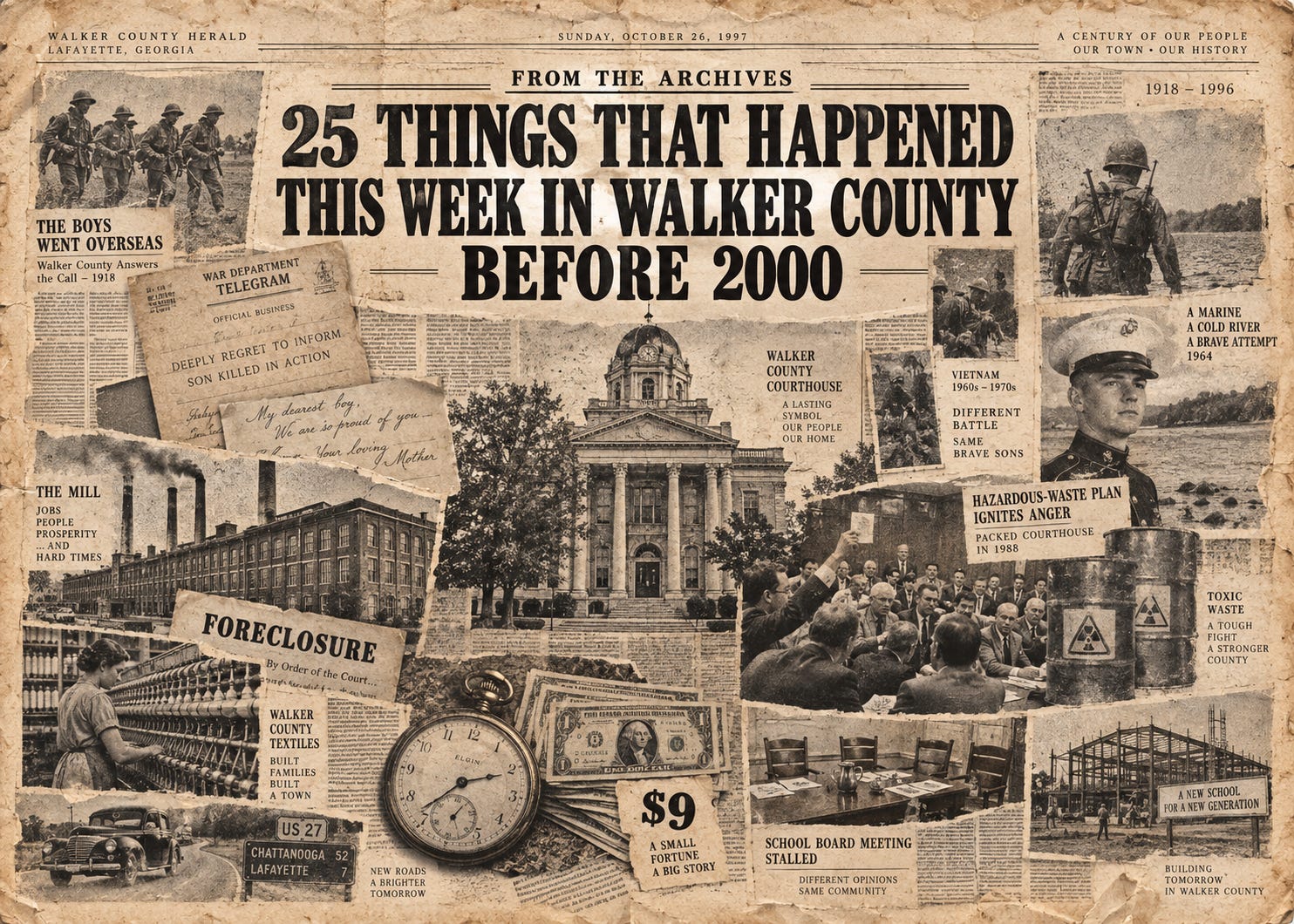
Here are 25 things happening this week in years past.
1. 1983: The Barwick empire heads for foreclosure
It is difficult to overstate how important E.T. Barwick Industries once was to Walker County.
Barwick was not simply a company with a plant here. At its height, it was part of the economic identity. Thousands of people worked for the company. Families depended on it. Local businesses depended on the families who depended on it.
Then came September 1983.
The Messenger reported that E.T. Barwick Industries property in Walker and Whitfield counties was scheduled for foreclosure sale on Nov. 1. That included Barwick’s LaFayette property.
There are grander ways to describe the collapse of an industrial giant, but few are more final than putting the real estate on the courthouse steps.
Source:
https://gahistoricnewspapers.galileo.usg.edu/lccn/sn89053488/1983-09-21/ed-1/seq-1/
2. 1988: Walker County packs the courthouse to fight Redox
If anyone believes environmental fights in Walker County began with Facebook groups and PowerPoint presentations, allow 1988 to enter the chat.
A standing-room-only crowd packed the Walker County Courthouse for a Georgia Environmental Protection Division hearing concerning Redox Inc.’s proposed hazardous-waste treatment facility on Highway 151 near the Walker-Catoosa line.
EPD officials said they had received roughly 700 letters about the project, reportedly the largest amount of correspondence the agency had received on a single issue.
Seven hundred letters.
This was back when objecting to something required locating a stamp.
Source:
https://gahistoricnewspapers.galileo.usg.edu/lccn/sn89053488/1988-09-21/ed-1/seq-1/
3. 1964: A 21-year-old LaFayette Marine dies trying to save a Boy Scout
Some stories do not need a clever introduction.
Marine Cpl. Rodney T. Taylor, 21, of LaFayette drowned while attempting to rescue a Boy Scout from icy water near the U.S. Naval Base at Reykjavik, Iceland.
Taylor was a 1961 graduate of LaFayette High School, belonged to Second Baptist Church and had worked at the Home Store before entering the military.
The Messenger put the story on the front page under the headline:
“Heroic Marine Drowns After Rescue Attempt.”
Hard to improve on that.
Source:
https://gahistoricnewspapers.galileo.usg.edu/lccn/sn89053488/1964-09-23/ed-1/seq-1/
4. 1965: A future four-star general is fighting in Vietnam
On Sept. 22, 1965, the Messenger carried a story headlined:
“IN VIET VILLAGE, WAR GETS PERSONAL, OFTEN DIRTY.”
The local connection was Army Capt. Ronald H. Griffith, whose family had ties to Rossville and LaFayette.
Griffith had reportedly been recommended for the Vietnamese Cross and Bronze Star following action in which he helped capture about 20 Viet Cong.
At the time, he was simply a young Army captain in Vietnam.
He would eventually become Gen. Ronald H. Griffith, a four-star general and vice chief of staff of the United States Army.
Not a bad career trajectory from a Walker County newspaper clipping.
Source:
https://gahistoricnewspapers.galileo.usg.edu/lccn/sn89053488/1965-09-22/ed-1/seq-1/
5. 1978: E.T. Barwick returns and talks about hiring
This one becomes considerably more interesting when read beside No. 1.
In September 1978, E.T. Barwick was back in control of the company bearing his name after creditors had pushed him aside several years earlier.
He told the Messenger there was a “great possibility” his return would mean more employment at the LaFayette and Kensington plants.
Barwick said he expected refinancing to be completed soon and hoped to increase production.
He did add one caveat:
“I can’t go back up to 2,500 people in one day.”
Five years later, company property was headed toward foreclosure.
Old newspapers have a habit of turning optimism into dramatic irony.
Source:
https://gahistoricnewspapers.galileo.usg.edu/lccn/sn89053488/1978-09-27/ed-1/seq-1/
6. 1986: Walker’s commissioner lands in a GBI ticket-fixing investigation
This story would have produced approximately 14,000 Facebook comments by lunchtime.
The Messenger reported on a Georgia Bureau of Investigation inquiry into alleged ticket fixing involving the Georgia State Patrol.
According to the GBI report cited by the newspaper, Trooper Alvin Phillips said Walker County Commissioner Roy Parrish Jr. asked him to void a DUI citation issued to another person.
Phillips reportedly refused. The report said Parrish then contacted other officials.
Parrish characterized what he did as performing “a favor for a friend.”
There is a phrase with a long and distinguished career in government.
Source:
https://gahistoricnewspapers.galileo.usg.edu/lccn/sn89053488/1986-09-26/ed-1/seq-1/
7. 1951: A Walker County capital case is moved to Atlanta
This is one of the darker entries.
James Avery, a 20-year-old Black construction worker, was convicted in Fulton County after a rape case originating in Chickamauga was moved out of Walker County.
The Messenger reported that Avery was sentenced to the electric chair. His court-appointed attorney, Frank Gleason, immediately announced plans to appeal to the Georgia Supreme Court.
The case involved a special Walker County grand jury, a change of venue and Avery’s removal from the local jail for safekeeping.
The newspaper’s own racial terminology reflects the Jim Crow era in which the story was written. It is uncomfortable reading now, as it should be.
Source:
https://gahistoricnewspapers.galileo.usg.edu/lccn/sn89053488/1951-09-26/ed-1/seq-1/
8. 1974: A former POW tells Walker Tech graduates what freedom means
Walker Tech graduated 123 students in September 1974.
Their commencement speaker was Col. Quincy Collins, who had spent seven years as a prisoner of war in Vietnam.
That gives a man somewhat more latitude than the average graduation speaker to discuss adversity.
Collins told graduates that “without freedom there can be nothing else.” His years in captivity, the paper reported, had strengthened his belief in God, country and family.
I suspect nobody checked his speech against the suggested 12-minute time limit.
Source:
https://gahistoricnewspapers.galileo.usg.edu/lccn/sn89053488/1974-09-25/ed-1/seq-1/
9. 1918: Walker County learns Ross Graham died in France
Corporal Ross Graham had died of wounds on June 16, 1918.
Walker County did not receive official confirmation until months later.
The Sept. 20 Messenger reported that Graham had enlisted in the Marines the previous December and gone overseas in the spring. The newspaper believed he had been wounded during fighting connected to the Marne offensive.
One detail makes the story particularly painful.
His mother had received a letter from him dated June 7.
Nine days later, according to the military notification, he was dead.
Before instant communication, even grief could arrive months late.
Source:
https://gahistoricnewspapers.galileo.usg.edu/lccn/sn89053488/1918-09-20/ed-1/seq-1/
10. 1944: A LaFayette mother receives the second telegram
Mrs. Myrtle Mullins of Cove Street already knew her son was missing.
Then came worse news.
The Navy Department notified her that James T. Mullins, a seaman second class in the Naval Reserve, had been killed in action April 17.
He had entered the Navy only the previous September, trained at Great Lakes and attended LaFayette High School.
National histories describe World War II with maps, armies and arrows.
Local newspapers show what it actually looked like.
A mother on Cove Street opening a message.
Source:
https://gahistoricnewspapers.galileo.usg.edu/lccn/sn89053488/1944-09-21/ed-1/seq-1/
11. 1985: Crystal Springs tells employees to start writing Ronald Reagan
Before online petitions made political activism possible from a recliner, Crystal Springs Print Works had a more labor-intensive system.
The company encouraged employees, family members and people throughout the community to write President Ronald Reagan in support of federal legislation aimed at restricting textile imports.
Crystal Springs even suggested what people might write:
“My parents work for a textile company.”
“Our community depends a great deal on the textile industry.”
“The future of our textile industry depends on it.”
There was also a drawing connected to the campaign.
Nothing boosts participatory democracy quite like a possible prize.
Source:
https://gahistoricnewspapers.galileo.usg.edu/lccn/sn89053488/1985-09-25/ed-1/seq-3/
12. 1961: Peerless Woolen Mills announces it is shutting down
This was enormous.
Peerless Woolen Mills in Rossville, which employed about 1,750 people, announced plans for gradual liquidation unless a buyer could be found.
General manager B.H. Hines blamed declining demand for traditional woolen products, competition from cheaper imports and consumers’ growing preference for lighter synthetic and blended fabrics.
This was 1961.
The phrase “globalization” had not yet become something politicians blamed during campaign speeches, but Walker County workers were already experiencing it.
Source:
https://gahistoricnewspapers.galileo.usg.edu/lccn/sn89053488/1961-09-27/ed-1/seq-1/
13. 1988: The newspaper reports that the newspaper has been sold
Journalists love becoming the story almost as much as dentists enjoy root canals.
On Sept. 23, 1988, the Messenger announced that all stock in Walker County Newspapers Inc. had been sold by Boone Newspapers Inc. of Tuscaloosa to News Publishing Company of Rome.
The deal had closed the previous day.
In a small community, newspaper ownership matters more than it might appear.
For generations, the local newspaper decided which council meeting mattered, which scandal received six inches and which scandal got Page 1.
It was the algorithm before algorithms.
Source:
https://gahistoricnewspapers.galileo.usg.edu/lccn/sn89053488/1988-09-23/ed-1/seq-1/
14. 1994: Zell Miller is coming to break ground at Walker Tech
Gov. Zell Miller was scheduled to visit Walker Technical Institute for the groundbreaking of a $4.7 million expansion.
The project was not small.
Plans called for about 49,000 square feet of additional space, including classrooms, laboratories, a library, a student center, cafeteria and office space.
The Messenger said it would nearly double the size of the campus.
Government officials today would call this “a transformational workforce development investment.”
In 1994, apparently, they just built the thing.
Source:
https://gahistoricnewspapers.galileo.usg.edu/lccn/sn89053488/1994-09-21/ed-1/seq-1/
15. 1944: The same front page brings another death from France
The Sept. 21, 1944, issue did not stop with the death of James Mullins.
Mr. and Mrs. William Orr of West Armuchee Valley had also been notified that their son, Pvt. Clyde Orr, had been killed in France on Aug. 25.
He had served in the armed forces for more than a year.
That is two local families learning from the same front page that their sons would not be coming home.
It is difficult to imagine reading the paper that morning.
Source:
https://gahistoricnewspapers.galileo.usg.edu/lccn/sn89053488/1944-09-21/ed-1/seq-1/
16. 1966: Walker County prepares for Arnall versus Maddox
Georgia’s 1966 Democratic gubernatorial runoff came through Walker County with two names that represented very different currents in state politics.
Former Gov. Ellis Arnall faced Atlanta businessman Lester Maddox.
The Messenger described Maddox as an “ardent segregationist.” He had narrowly defeated Jimmy Carter for second place in the first primary.
Walker voters also had a lieutenant governor’s runoff and a local judicial contest waiting for them.
It was one of those elections that looks even more consequential in retrospect because Georgia itself was changing underneath it.
Source:
https://gahistoricnewspapers.galileo.usg.edu/lccn/sn89053488/1966-09-21/ed-1/seq-1/
17. 1990: “No quorum, no tax rate and no hope”
Every once in a while a newspaper headline achieves perfection.
This was one of those times.
“No quorum, no tax rate and no hope.”
The Walker County Board of Education had failed four times to conduct business because members could not assemble a working quorum and were feuding over the agenda.
Chairman Renn Hise and board members Patti Keown and Mike Fuller were among those locked in the dispute, which included controversy surrounding Naomi School. Fuller was also involved in litigation over his eligibility to serve.
So if you ever hear someone yearning for the civility and efficiency of local government in the good old days, clip this one out for them.
Source:
https://gahistoricnewspapers.galileo.usg.edu/lccn/sn89053488/1990-09-21/ed-1/seq-1/
18. 1950: A Korean War death notice comes with a terrible question mark
The Messenger reported that Lt. Richard Brinsley Sheridan, husband of the former Helen McKown of LaFayette, had apparently been killed in Korea.
Apparently.
His family still had hope because there appeared to be some discrepancy in the War Department’s notification.
There may be few things worse than receiving word that someone you love has been killed.
One of them might be receiving that word while still having just enough reason to wonder whether it is true.
Source:
https://gahistoricnewspapers.galileo.usg.edu/lccn/sn89053488/1950-09-27/ed-1/seq-1/
19. 1975: Two killed and five injured on Highway 193
A head-on collision on Georgia Highway 193 in Chattanooga Valley killed both drivers and injured five other people.
The dead were identified as Marion Arthur Madaris of Chattanooga Valley and Gary Eugene Wilson, 25, of East Ridge.
Madaris’ wife and three children were injured, along with a passenger in Wilson’s vehicle. Two of the children were reported in critical condition.
According to the State Patrol account, Wilson’s vehicle crossed to the wrong side of the highway after cresting a hill and entering a curve.
Some newspaper stories become history.
Others remain what they were the morning they were printed. A family’s nightmare.
Source:
https://gahistoricnewspapers.galileo.usg.edu/lccn/sn89053488/1975-09-24/ed-1/seq-1/
20. 1984: Walker County gets a Director of Industry and Trade
Commissioner Roy Parrish Jr. announced that state Rep. Donald F. Oliver had been appointed Walker County’s Director of Industry and Trade.
The job was intended to strengthen Walker County’s economic-development efforts and help organize its pursuit of new industry.
This is a useful marker in the evolution of local government.
There was a time when a county’s economic-development strategy amounted largely to having land, electricity and someone who knew the governor.
By the 1980s, governments were hiring people specifically to chase factories.
A whole profession was being born.
Source:
https://gahistoricnewspapers.galileo.usg.edu/lccn/sn89053488/1984-09-26/ed-1/seq-1/
21. 1945: Eddie Mae Leath comes home between military assignments
Pvt. Eddie Mae Leath, a medical technician, spent several days visiting relatives and friends around Cooper Heights and Rossville while transferring from Nichols General Hospital in Louisville to March Field, California.
That would be an interesting little wartime item on its own.
Then comes the final detail.
Her brother, Jerry G. Leath of the Army Air Force, had been missing since Oct. 20, 1944.
One child home briefly in uniform.
Another still missing.
World War II may have ended in 1945, but plenty of Walker County families did not get a clean ending.
Source:
https://gahistoricnewspapers.galileo.usg.edu/lccn/sn89053488/1945-09-20/ed-1/seq-1/
22. 1996: The new LaFayette High begins taking shape
By September 1996, enough steel and concrete had gone up along Round Pond Road for people to see that the new LaFayette High School was becoming real.
The school board held a reception honoring the state and local officials involved in the project.
The Messenger headline said “cooperation” had resulted in $1 million in savings.
The new school sat on a 92-acre site and was expected to open the following fall.
Every public building spends a few years being “the new one.”
Then suddenly it has alumni old enough to complain about how much better things were when they went there.
Source:
https://gahistoricnewspapers.galileo.usg.edu/lccn/sn89053488/1996-09-27/ed-1/seq-1/
23. 1996: Walker County adopts a $17 million budget
Commissioner Roy Parrish adopted Walker County’s fiscal 1997 budget at roughly $17 million.
That was about 4 percent higher than the previous year.
The Sheriff’s Department, road operations and special-purpose sales-tax projects each accounted for more than $3 million. Administration topped $2.1 million. The court system received a little more than $1 million.
The dollar amounts have changed dramatically since then.
The categories have not.
Sheriff. Roads. Courts. Administration. Taxes.
Local government has been remixing the same album for decades. County-wide budgets today far exceed the modest sums from 1997.
Source:
https://gahistoricnewspapers.galileo.usg.edu/lccn/sn89053488/1996-09-20/ed-1/seq-1/
24. 1983: Kathryn McDonald says she will seek her husband’s seat
The Sept. 23 Messenger carried a large headline:
“Kathryn McDonald will run.”
Her husband, Seventh District Congressman Larry McDonald, had been killed earlier that month when Korean Air Lines Flight 007 was shot down by the Soviet Union.
Kathryn McDonald entered the special election to replace him in Congress.
What followed was a remarkable collision of local politics and the Cold War. A congressional election in Northwest Georgia had suddenly become tied to one of the biggest international incidents of the decade.
Buddy Darden eventually won the seat.
But for a few weeks in 1983, the road from Walker County politics ran straight through Moscow.
Source:
https://gahistoricnewspapers.galileo.usg.edu/lccn/sn89053488/1983-09-23/ed-1/seq-1/
25. 1937: A watch, nine dollars and one busy sheriff’s office
We finish with crime news from 1937.
Following the capture of the Jennings gang in connection with an attempted Chattanooga bank robbery, the Messenger reported that Sheriff Creed Shelby and deputies Wardell Griffin and John Zimmerlee had been “exceedingly busy apprehending criminals.”
Among the cases was Truman Harold, jailed in connection with items stolen from Frank Shaw’s store at Davis Cross Roads.
Another man was returned as a fugitive.
And five Black men were jailed on accusations they robbed railroad worker Thomas Wingo at Blowing Springs.
The alleged loot was his watch and $9.
Nine dollars in 1937 was not pocket change.
Still, there is something wonderfully old-newspaper about an entire crime story boiling down to:
Man relieved of watch and nine dollars. Sheriff displeased.
Source:
https://gahistoricnewspapers.galileo.usg.edu/lccn/sn89053488/1937-09-24/ed-1/seq-1/
A note about how I did this
This is part of a larger project I have been working on to dig through old editions of the Walker County Messenger and surface stories that would otherwise remain buried several thousand newspaper pages deep.
For this list, I focused on surviving pre-2000 issues published from Sept. 20 through Sept. 27 in the Georgia Historic Newspapers collection maintained online through the Digital Library of Georgia.
I used AI and automated tools to help search the archive, process OCR, identify names and subjects, compare issues, group related items and narrow a very large pile of newspaper material into stories worth reading.
For the final list, the selected dates and newspaper issues were checked against the archive records, and the descriptions were reconciled with the available scanned page page information.
Historic newspaper scans and OCR are sometimes excellent.
Other times it looks as if the page was read aloud to a drunk court reporter underwater.Old typefaces, damaged paper, faded ink and newspaper columns can produce some spectacular nonsense.
That is why every entry above includes the direct archive URL. You can click it, look at the original page and decide for yourself.
Which is ultimately what makes this project worthwhile.
Walker County’s history is not lost or locked away in some distant state archive. A great deal of it is sitting online.
We just finally have tools good enough to dig through it.