The most troubling government stories rarely begin with a smoking gun. They begin with a few dates, a few documents, and a sequence of events and actions that nobody in power seems eager or even willing to explain.
That is where Walker County Government now finds itself.
Audia Group arrived in Walker County back in 2015 as a prized industrial recruit. According to the company’s recently filed federal lawsuit, part of what what drew Audia to the industrial park was an agreement in which Walker County promised incentives that included an option to purchase on nearby expansion property and a commitment for the county to make that land “pad-ready.” Audia says it invested nearly $90 million and created almost 125 jobs since opening shop here.
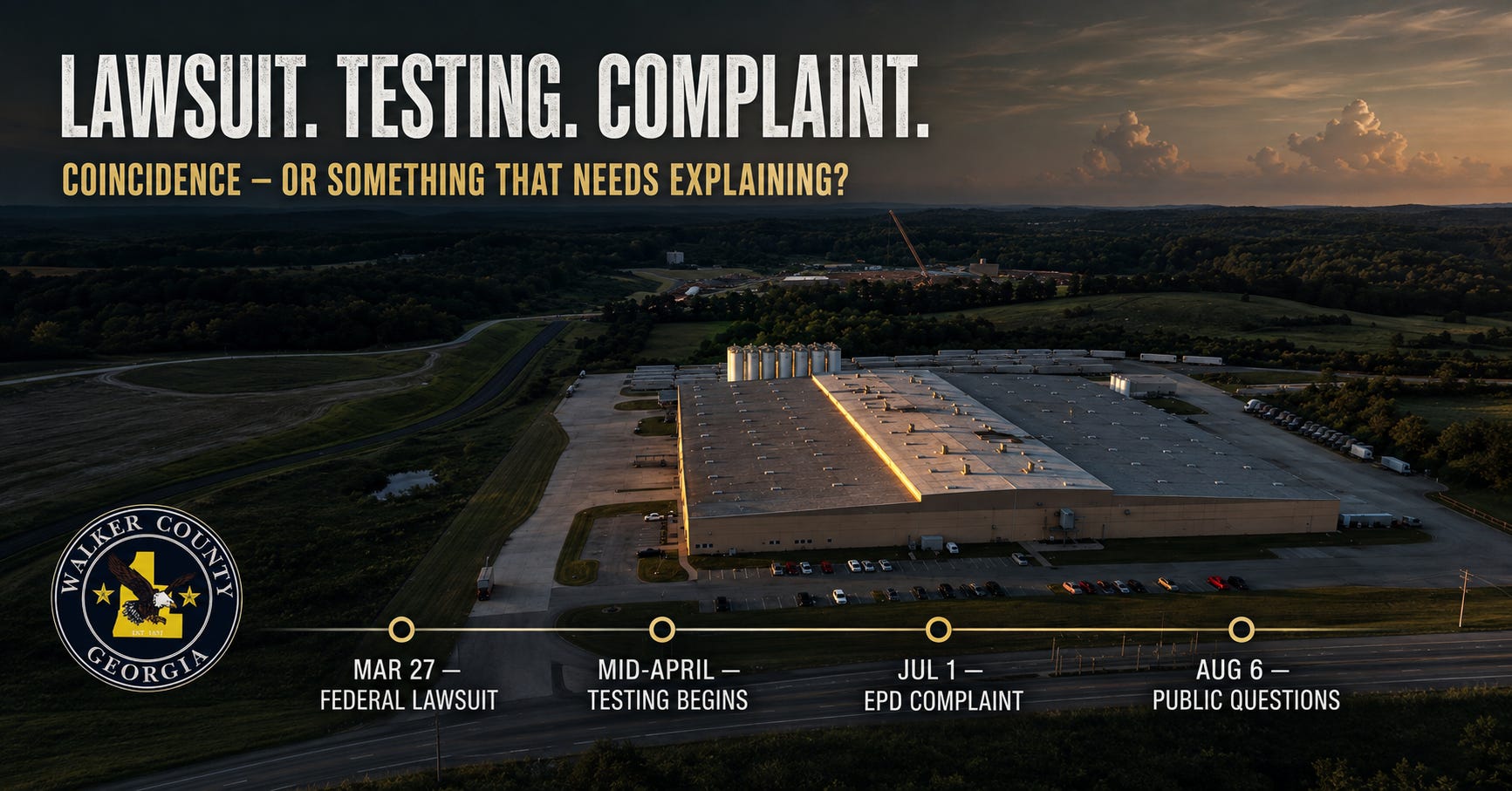
Audia says it exercised its property option in December 2024. The dispute ran through 2025, with the county and Development Authority reportedly refusing to honor the option or negotiate a settlement. On March 27th of this year, Audia sued in federal court.
Then, within weeks, something else began happening. Something odd. We didn’t learn about it though until very recently.
At the August 6 Walker County Commission meeting, citizen Stanley Matthews described events he said began in mid-April. Matthews said Commissioner Mark Askew, working with County Attorney Ken Gerard, was involved in arranging soil and water sampling at the Walker County Industrial Park. He said county department heads inspected locations and that a professional environmental company later collected samples.
“These samples were sent for analysis, and the results of the analysis were returned to the county,” Matthews said.
Then he asked the question every resident should be asking now: “What were the results?”
Askew replied, “I haven’t seen them. I haven’t seen the results.”
That answer should have stirred the room.
If the county was concerned enough about possible contamination to send employees into the industrial park and pay professionals to collect soil or water samples, what did those samples show? If the tests found nothing, releasing the results would reassure the public. If they found something, the public’s interest in knowing was greater still.
Instead, months later, the results sit in county hands with no public disclosure or explanation of what they contained. Or even what prompted the tests.
Just as telling is what did not happen while Matthews spoke.
No commissioner disputed his account. Nobody said the testing never happened. Nobody said county employees were never sent out. Nobody challenged the collection or return of the samples. Askew’s response appeared to confirm the central fact. The testing existed. The results came back. He simply said he had not seen them.
And people noticed. In the six days after the meeting, the roughly six-minute video of Matthews’ comments drew nearly 100,000 views. That is extraordinary attention for a video of a public comment at a county commission meeting. It suggests residents already sense that something here needs explaining.
Matthews went further. He said that after the results were returned, county personnel tried to inspect the sewers of a company in the industrial park and were refused entry. Then he added: “Keep in mind, the company in question is currently involved in litigation with Walker County in federal court.”
The sewer inspection raises its own question. Walker County government does not operate a water or sewer utility. The Walker County Water & Sewerage Authority is an independent entity, and other utilities serve the county. County government has not traditionally been the agency inspecting industrial sewer systems.
So why was it trying or doing so here?
If officials believed an industrial discharge posed a danger, you would expect the utility serving the property, environmental-health officials, EPD, or some combination of the proper regulators to step in. Why did county government use its own personnel?
That may have a sensible explanation. But when it happens within weeks of the county being sued by the company in question, it is a mkre than reasonable question.
Then came July 1.
Georgia Environmental Protection Division Complaint 117383 concerns the Audia facility and remains listed as “Under Investigation.” The public complaint record identifies the caller as “an attorney that represents Walker County Development Authority.” The complaint alleges improper chemical disposal or discharge, possible effects on water quality, and “wildlife kills.”
Those are serious allegations. They are also only allegations. EPD has not determined that Audia polluted anything.
What matters is the timeline and the identity of the caller. By July 1, the Walker County Development Authority was already a defendant in Audia’s lawsuit.
Put the sequence together. Audia sues on March 27. County-linked environmental sampling begins within weeks. The results come back to the county and stay publicly undisclosed. County employees then attempt a sewer inspection the county has no utility role in performing. Then an attorney for one of the defendants in Audia’s lawsuit calls EPD with environmental allegations against Audia.
That sequence does not prove coercion or retaliation. It does make the possibility impossible to dismiss without answers.
There is a legitimate side to this. If county officials received credible information suggesting contamination, they had every right, and perhaps an obligation, to act. But that still does not explain what triggered the testing, why county employees carried it out, what the laboratory found, who received the findings, what passed between county officials and Development Authority representatives, or what prompted the July 1 complaint.
Then there is the records issue.
At the August 6 meeting, citizen Evelyn Garmany asked how records Matthews said had been refused could be withheld. Chairwoman Angie Teems answered: “Because it’s in litigation.”
That is not a magic phrase.
Pending litigation does not place every government record behind a curtain. Certainly not these records. If records were withheld, the county should name the specific legal exemption it relied on. Otherwise, release them. If those records include environmental testing with public-health implications, it is more troubling still.
Perhaps every step taken by the county and officials was proper. Perhaps every test, inspection, and complaint had a legitimate basis wholly unrelated to Audia’s lawsuit.
Then the county should be eager to prove it.
Release the laboratory results. Release the authorizations. Release the inspection records and communications for it all. Explain who initiated the testing, what triggered it, who saw the results, why county employees were sent to inspect a sewer system the county does not operate, and what led an attorney for the Development Authority to contact EPD about Audia.
The public does not need another explanation for why it cannot see the evidence. It needs the evidence.
When government begins investigating a company weeks after being sued by thst company, keeps potentially important environmental test results from public view, and then cites that same litigation as its reason for withholding records, the burden shifts.
Walker County holds the records and documents that can make this whole thing look entirely ordinary, or considerably worse.
At this point, refusing to produce them is no longer separate from the story.
It is becoming part of it.